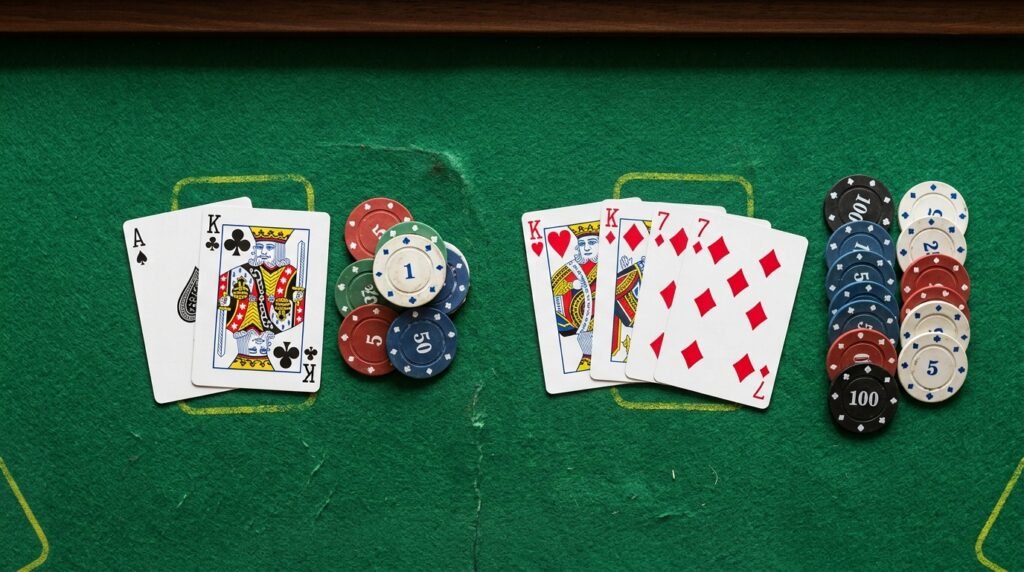
Blackjack is easier to learn because it has fixed rules and no opponents to read — you just play against the dealer’s hand. Poker is harder at first because it involves psychology, betting strategy, and reading other players, but it rewards long-term skill more.
Ask ten casino regulars which game is easier, and you’ll probably get ten different answers. That’s because “easier” means something different depending on what you’re comparing — memorizing rules, making quick decisions, or reading other people. When people ask blackjack vs poker which is easier, they’re usually trying to figure out where to start as a beginner. This guide breaks down both games piece by piece, so you can see exactly where each one demands more from you, and where it doesn’t.
By the end of this article, you’ll understand the rule structures of both games, the mental skills each one demands, common beginner mistakes, and how the learning curves actually compare side by side.
What Makes a Casino Game “Easy” or “Hard” to Learn
Before comparing the two games directly, it helps to define what “easy” actually means here. Beginners often confuse simple rules with simple gameplay — but these are two different things entirely.
A game can have short, clean rules (like blackjack) yet still take time to play well. A game can have longer rules (like poker) yet become intuitive once the terminology sinks in. When evaluating blackjack vs poker which is easier, three factors matter most:
- Rule complexity — how many rules you need to memorize before you can play at all
- Decision complexity — how much thinking each turn requires
- Social complexity — whether you’re reacting to other people or just to cards and numbers
Blackjack scores low on all three. Poker scores low on rule complexity but high on decision and social complexity. That distinction is the core of this whole comparison.
Blackjack Rules Explained Step-by-Step
Blackjack’s structure is famously compact, which is why it’s often recommended as a first casino game. Here’s the basic sequence:
- Each player receives two cards, dealt face up in most versions
- The dealer receives one card face up and one face down (the “hole card”)
- Players decide whether to hit (take another card), stand (keep their current total), double down, or split pairs
- The goal is to get a hand value closer to 21 than the dealer’s, without going over
- Face cards count as 10, aces count as 1 or 11, and number cards count as their face value
- Once all players finish their turns, the dealer reveals the hole card and plays according to fixed rules (usually hitting until reaching 17)
- Hands are compared, and bets are settled based on who’s closer to 21
That’s essentially the entire rulebook. There’s no reading opponents, no betting rounds against other players, and no bluffing involved.
Pro Tip: Learn basic strategy charts before playing — they tell you the mathematically correct move for every hand combination, removing guesswork entirely.
Poker Rules Explained Step-by-Step
Poker’s rules vary by variant, but Texas Hold’em is the most common starting point:
- Each player receives two private cards (“hole cards”)
- A round of betting occurs based on those two cards alone
- Three community cards are dealt face up (the “flop”), followed by another betting round
- A fourth community card is dealt (the “turn”), followed by another betting round
- A fifth community card is dealt (the “river”), followed by a final betting round
- Remaining players reveal their hands, and the best five-card combination wins
- Betting options include check, call, raise, or fold at each stage
Already, you can see the difference — poker has multiple betting rounds, hidden information about opponents’ cards, and decisions that depend on what other people might be holding, not just your own hand.
How the Mechanics Actually Work
This is where blackjack vs poker which is easier becomes clearer. Blackjack is a closed-information game against a fixed opponent — the dealer follows set rules and never bluffs, never changes strategy, and never reacts emotionally. Every decision you make can be reduced to math: given your hand and the dealer’s visible card, there’s one statistically correct action.
Poker is an open-strategy game against unpredictable opponents. The mechanics involve incomplete information (you don’t know what others hold), variable betting (which changes the size of the risk), and psychological elements like bluffing and reading behavior. Two people can hold identical cards in poker and get completely different results depending on how they bet.
Pro Tip: If you’re new to card games generally, blackjack lets you practice decision-making under simple, repeatable conditions before introducing the added complexity of opponents.
Common Beginner Mistakes in Both Games
Beginners tend to stumble in predictable ways in each game:
Blackjack mistakes:
- Standing too early out of fear of busting, even when basic strategy says to hit
- Not understanding when to split pairs or double down
- Forgetting that dealer rules are fixed, so there’s no point trying to “read” the dealer
Poker mistakes:
- Playing too many starting hands instead of folding weak ones
- Overvaluing a strong hand pre-flop without considering community cards
- Betting emotionally after a loss instead of sticking to a consistent strategy
Both sets of mistakes come from the same root cause: skipping the fundamentals and relying on instinct instead of structure.
Key Terminology You Need to Know
Understanding terminology speeds up the learning curve for both games.
Blackjack terms:
- Hit — take another card
- Stand — keep your current hand
- Bust — exceed 21 and automatically lose
- Soft hand — a hand containing an ace counted as 11
Poker terms:
- Fold — give up your hand and forfeit the pot
- Flop, turn, river — the three stages of community cards
- Pot odds — the ratio of the current pot size to the cost of a call
- Bluff — betting aggressively with a weak hand to make opponents fold
According to the official rules published by the [External Link Suggestion: Bicycle Cards or a recognized card game rules authority], these terms are standardized across most casino variants, which makes learning them once useful across multiple games.
Strategy Tips for Understanding Each Game Better
For blackjack, the fastest way to build confidence is memorizing a basic strategy chart. It’s a reference table showing the correct action for every possible hand versus every dealer up-card. Once memorized, decision-making becomes close to automatic.
For poker, understanding starting hand strength is the equivalent first step. Learning which hands are worth playing before the flop — and which ones to fold immediately — cuts down on costly early mistakes. From there, players gradually build an understanding of position (where you sit relative to the dealer) and pot odds.
Pro Tip: Treat blackjack strategy charts and poker starting-hand charts the same way — as reference tools to study away from the table, not something to calculate on the fly during play.
Myths vs Facts
Myth: Blackjack is just luck, so there’s nothing to learn.
Fact: Basic strategy is mathematically derived and significantly changes long-term outcomes compared to guessing.
Myth: Poker is only about bluffing.
Fact: Bluffing is one tool among many; understanding odds, position, and hand ranges matters more overall.
Myth: If you’re good at blackjack, you’ll pick up poker quickly.
Fact: The skill sets barely overlap — blackjack rewards memorization, poker rewards adaptability and reading people.
Myth: Poker takes years to understand at even a basic level.
Fact: The core rules can be learned in under an hour; it’s the strategic depth that takes longer to master.
Blackjack vs Poker: Side-by-Side Comparison
| Factor | Blackjack | Poker |
|---|---|---|
| Rule complexity | Low | Moderate |
| Time to learn basic rules | Under 15 minutes | 30–60 minutes |
| Opponent interaction | None (vs. dealer only) | High (vs. other players) |
| Decision type | Fixed, math-based | Variable, psychology-based |
| Bluffing involved | No | Yes |
| Beginner-friendliness | High | Moderate |
| Long-term skill ceiling | Moderate | High |
Conclusion
When comparing blackjack vs poker which is easier, the honest answer is that blackjack wins for pure beginner accessibility — simple rules, no opponents to read, and a clear mathematical strategy to follow. Poker takes longer to feel comfortable with because it adds betting rounds, hidden information, and human unpredictability into the mix.
To recap the three biggest takeaways:
- Blackjack has fewer rules and no social component, making it faster to learn
- Poker involves reading opponents and managing incomplete information, which raises the learning curve
- Both games reward structured strategy over guesswork — memorization for blackjack, hand-range thinking for poker
So which one matches how you like to think — quick math decisions, or reading people and probability over time? Consider starting with our guide to blackjack basic strategy charts if you want a structured first step. Whichever game you choose, understanding the mechanics first will always beat playing on instinct alone.
FAQs
Is blackjack easier to learn than poker?
Yes, for most beginners. Blackjack has a fixed rule structure and no opponents to read — you’re only reacting to your own hand and the dealer’s visible card. Poker requires understanding betting rounds, community cards, and reading other players, which takes longer to feel natural, even though the basic rules themselves aren’t overly complicated.
Which game requires more skill, blackjack or poker?
Poker has a higher skill ceiling long-term because it involves psychology, incomplete information, and adaptable strategy against unpredictable opponents. Blackjack skill is more finite — once you’ve memorized basic strategy, there’s little more to learn strategically, since the dealer’s actions never change.
Can beginners play blackjack without knowing strategy?
Yes, but it’s not recommended if you want to understand the game properly. To play with basic competence, beginners should:
- Learn hand values and what busting means
- Understand when to hit, stand, split, or double down
- Study a basic strategy chart for reference
Skipping these steps makes decisions feel random rather than informed.
Why does poker feel harder than blackjack for new players?
Poker feels harder because it introduces variables that blackjack doesn’t have — betting rounds, hidden opponent cards, bluffing, and shifting hand strength as community cards are revealed. Blackjack removes all of that by keeping the format fixed and math-based, which is why new players often find it more approachable.
Do blackjack and poker use the same card rankings?
No. Blackjack cares about numeric hand totals close to 21, where face cards equal 10 and aces are 1 or 11. Poker uses traditional hand rankings like pairs, straights, flushes, and full houses, based on five-card combinations, which is a completely different scoring system beginners need to learn separately.
Which game is better for someone who doesn’t like interacting with others?
Blackjack suits players who prefer minimal social interaction, since you’re playing against fixed dealer rules rather than reacting to other people’s behavior or bluffs. Poker inherently involves reading and reacting to opponents, so it may feel less comfortable for players who prefer straightforward, low-interaction gameplay.