Roulette works by spinning a numbered wheel (0–36, or 0–00–36 in American versions) while a ball spins in the opposite direction. Players bet on where the ball will land — a single number, a color, or a group of numbers — before the spin. When the ball settles into a pocket, winning bets are paid according to fixed odds.
Introduction
Spin a roulette wheel and you’re watching physics, probability, and a little bit of tradition collide in real time. If you’ve ever stood near a roulette table and felt lost by the chips, numbers, and shouted terms, you’re not alone — this is one of the most misunderstood games in any casino. Understanding how roulette works isn’t complicated once you break it into its parts: the wheel, the table layout, the bet types, and the payout math behind them. By the end of this guide, you’ll know exactly what happens from the moment the ball drops to the moment the dealer pays out, and you’ll be able to follow a round without feeling like everyone else is in on a secret you’re not.
What Is Roulette and Why Beginners Struggle With It
Roulette looks simple from a distance: a spinning wheel, a bouncing ball, a table covered in numbers. The confusion usually starts once you get closer.
New players often struggle because there are two different wheel layouts (European and American), a table full of overlapping betting zones, and a dealer moving fast enough that it’s easy to feel behind before you’ve even placed a chip. None of this is complicated logic — it’s just unfamiliar vocabulary layered on top of unfamiliar visuals.
The good news is that roulette has no hidden skill requirement. Once you understand the wheel and the bet types, the rest is just repetition.
How Roulette Works: Step-by-Step Rules
Here’s the basic sequence of a single round, from start to finish:
- Betting opens — Players place chips on the table layout, choosing numbers, colors, or groups of numbers.
- The dealer spins the wheel — The wheel spins in one direction while the ball is released in the opposite direction.
- “No more bets” is called — At a certain point, the dealer signals that no further chips can be placed.
- The ball loses momentum — It drops from the outer track into the spinning wheel and bounces between number pockets.
- The ball lands — Once it settles into a numbered pocket, that number is the winning result.
- Losing bets are cleared — The dealer removes all chips that didn’t win.
- Winning bets are paid — Payouts are calculated based on the type of bet and its fixed odds.
- The next round begins — Betting reopens, and the cycle repeats.
The Mechanics Behind the Wheel and Table
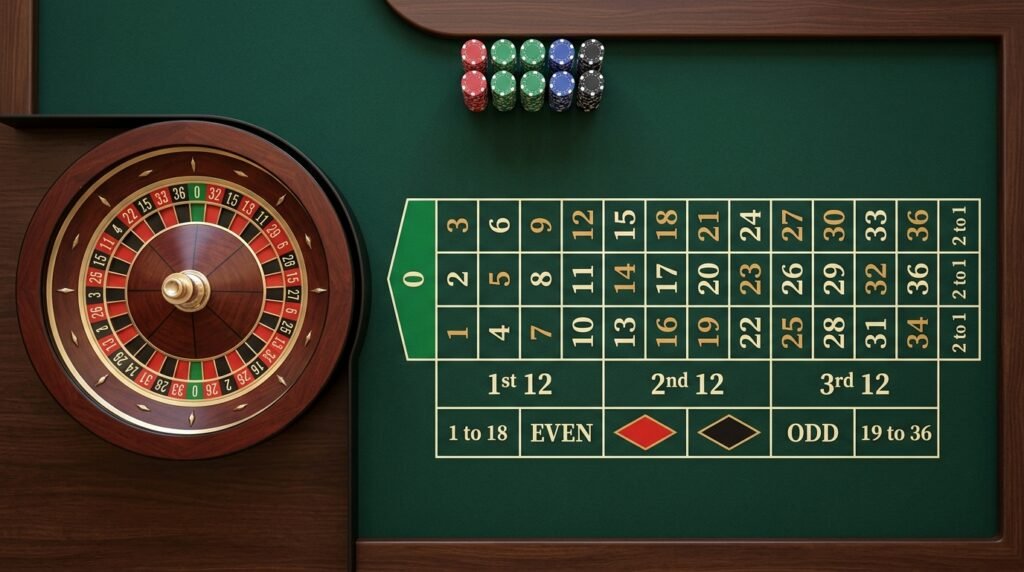
The wheel itself has either 37 pockets (European: 0 through 36) or 38 pockets (American: 0, 00, through 36). This single extra pocket in the American version changes the odds slightly, which is why most guides recommend understanding both before playing either.
The betting table is a separate surface laid out in a grid, mirroring every number on the wheel plus additional betting zones for colors, odd/even, and number ranges. Because the wheel and table are physically separate, the layout can feel disconnected at first — but the numbers always correspond directly.
Pro Tip: Spend five minutes just matching table numbers to wheel numbers before worrying about strategy. This alone removes most of the early confusion.
Each spin is an independent event. The wheel doesn’t “remember” previous results, which is a mechanical fact that trips up a lot of beginners who assume patterns exist where none do.
Common Beginner Mistakes to Avoid
Even simple games have common trip-ups, and roulette has a few that show up again and again:
- Confusing inside and outside bets — Inside bets (specific numbers) and outside bets (colors, ranges) have very different odds and payout structures.
- Assuming past spins affect future spins — Each spin is independent; there’s no “due” number.
- Not knowing the table layout before playing — This slows down decision-making and creates confusion during fast-paced rounds.
- Overlooking the house edge difference — European wheels have a lower house edge than American wheels because of the single vs. double zero.
- Misreading chip placement zones — Bets placed slightly off a line can accidentally become a different bet type entirely.
Roulette Terms and Terminology Explained
Roulette has its own vocabulary, and knowing it makes everything else click faster:
- Inside bet — A bet placed on specific numbers or small groups of numbers on the inner grid.
- Outside bet — A bet placed on broader categories like red/black, odd/even, or number ranges.
- Straight-up bet — A bet on a single number.
- Split bet — A bet covering two adjacent numbers.
- House edge — The mathematical advantage built into the game’s payout structure.
- En prison / La partage — Special European rules that return part of a bet if the ball lands on zero.
Understanding these terms turns a chaotic-looking table into a readable one.
Tips for Understanding Roulette Better (Not Strategy for Winning)
Because roulette outcomes are random and independent, there’s no method that changes the odds of any given spin. What actually helps beginners is understanding the game’s structure clearly enough to follow it in real time.
Focus on learning the difference between bet categories first, since this affects both payout size and win frequency. Watch a few rounds before participating in your mind (or in a free/demo setting) to see how quickly the wheel-to-table connection becomes intuitive.
Pro Tip: Learning the payout odds for each bet type (not memorizing them) helps you understand why certain bets pay more — bets that cover fewer numbers pay more because they’re less likely to hit.
Myths vs. Facts About Roulette
| Myth | Fact |
|---|---|
| A number is “due” after not appearing for a while | Every spin is statistically independent |
| Betting patterns can beat the house edge | The house edge is fixed regardless of betting pattern |
| European and American roulette are the same | American roulette has an extra pocket (00), changing the house edge |
| Watching previous spins helps predict the next one | Past results have no mathematical influence on future spins |
| Roulette requires skill to understand outcomes | Outcomes are random; only bet selection is a player decision |
Bet Types and Odds Comparison Table
| Bet Type | Description | Numbers Covered | Approx. Payout |
|---|---|---|---|
| Straight-up | Single number | 1 | 35:1 |
| Split | Two adjacent numbers | 2 | 17:1 |
| Street | Row of three numbers | 3 | 11:1 |
| Corner | Four numbers in a block | 4 | 8:1 |
| Red/Black | Color group | 18 | 1:1 |
| Odd/Even | Number parity | 18 | 1:1 |
| Dozen | Group of 12 numbers | 12 | 2:1 |
Conclusion
Roulette isn’t as complicated as it first appears. Once you understand that the wheel and table are simply mirrored systems, that each spin is independent, and that bet types determine both risk and payout, the entire game becomes far easier to follow.
The three things worth remembering most: the wheel and ball movement are separate systems that meet at the result, inside and outside bets carry very different odds, and no past spin ever influences a future one.
Next time you see a roulette table, what will you look for first — the wheel, the numbers, or the betting zones? Understanding the answer might be the difference between watching in confusion and watching with real clarity.
If you’d like to go deeper, a natural next read is a breakdown of European vs. American roulette differences, since that single extra pocket changes more than people expect.
FAQs
How does roulette work in simple terms?
Roulette works by spinning a numbered wheel while a ball spins in the opposite direction inside it. Players place bets before the spin on where they think the ball will land — a specific number, a color, or a broader category. When the ball settles into a pocket, that number determines which bets win, and payouts are calculated based on fixed odds tied to each bet type.
What’s the difference between European and American roulette?
The core difference is the wheel itself. European roulette has 37 pockets (0–36), while American roulette has 38 pockets (0, 00–36). This affects the game’s math in a few ways:
- American wheels have a higher house edge due to the extra pocket.
- European wheels sometimes include special rules (en prison/la partage) that soften losses on zero.
- Table layouts differ slightly between versions.
Is roulette a game of skill or luck?
Roulette is a game of chance. The wheel’s outcome is random and independent each spin, meaning no amount of observation or betting pattern changes the underlying odds. The only decision within a player’s control is which type of bet to place, not the outcome itself.
Why do inside bets pay more than outside bets?
Inside bets cover fewer numbers, making them statistically less likely to win, so they carry higher payouts to balance that risk. Outside bets cover far more numbers (like an entire color), making them more likely to win but with much smaller payouts. This relationship exists throughout the entire bet type structure.
Does the roulette wheel remember previous spins?
No. Each spin is a fully independent event with no memory of past results. This is a foundational fact in understanding how roulette works, since many beginner misconceptions come from assuming otherwise, such as believing a number is “due” to appear.
What is the house edge in roulette?
The house edge is the built-in mathematical advantage reflected in the payout structure rather than the odds of any single spin. European roulette typically has a lower house edge than American roulette because of the difference in wheel pockets. This edge remains constant regardless of betting strategy or spin history.