The oldest casino games in the world include dice games dating back over 5,000 years, card games from 9th-century China, and roulette from 18th-century France. These games evolved from ancient rituals, military pastimes, and mathematical experiments into the structured formats played today.
Introduction
Long before flashing lights and shuffled decks, people were rolling carved bones across dirt floors to test their luck. The oldest casino games in the world trace back thousands of years, evolving from ancient rituals into the structured games recognized today. Some began as tools for religious divination. Others started as military training exercises or royal pastimes that trickled down to common folk. This guide walks through where these games came from, how their rules developed, and why understanding their history actually makes you a sharper, more confident player. You’ll learn the timeline of each game’s origin, the mechanics behind their staying power, and the myths that still surround them.
What Are the Oldest Casino Games in the World, and Why Do Beginners Struggle With Them?
Casino games didn’t appear overnight in a Las Vegas boardroom. They developed gradually across centuries, shaped by different cultures, materials, and social customs. Dice games are widely considered the oldest, with archaeological evidence of bone dice found in sites dating back to around 3000 BCE in Mesopotamia and Egypt.
Beginners often struggle here because modern versions of these games carry layers of accumulated rules that weren’t part of the original design. A game like craps, for example, looks intimidating today because of its betting layout, but its dice-rolling foundation is remarkably simple and ancient. Understanding the historical core of a game strips away the confusion added over centuries of refinement.
Card games present a different challenge. Because playing cards evolved independently in China, Persia, and Europe, many rule variations exist side by side. New players often conflate different regional traditions, which creates unnecessary confusion when learning terminology or structure.
The Historical Timeline: Rules and Development Explained Step-by-Step
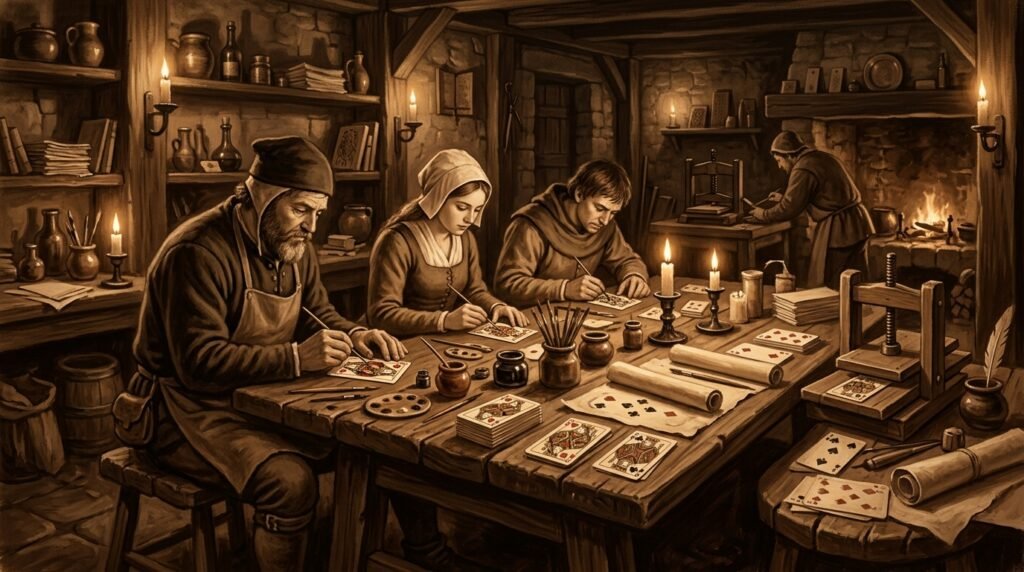
Tracing the evolution of these games helps clarify how modern rules came to be. Here’s a simplified timeline:
- 3000 BCE — Dice games emerge. Carved animal bones (astragali) were used in Egypt and Mesopotamia, often for divination before becoming games of chance.
- 9th century CE — Card games appear in China. Early paper cards developed during the Tang Dynasty, likely tied to paper currency innovations.
- 14th century — Cards spread to Europe. Playing cards reached Europe through trade routes, with Italy and Spain producing some of the earliest documented decks.
- 17th century — Baccarat develops in Italy and France. The game moved from Italian aristocratic circles into French royal courts.
- 1638 — The first legal gambling house opens in Venice. The Ridotto formalized structured gaming in a dedicated space.
- 1796 — Roulette takes shape in Paris. Blaise Pascal’s earlier experiments with a perpetual motion device are often credited as a mechanical ancestor of the roulette wheel.
- 19th century — Poker develops in the United States. It grew from earlier European bluffing games like Poque and the Persian game As-Nas.
Each stage added structure, but the core mechanics of chance and probability remained constant throughout.
How These Games Actually Work: The Mechanics Behind the History
Despite their age, the mechanical principles behind these games are surprisingly consistent. Dice games rely on random distribution of outcomes across a fixed number of faces, a mathematical property that hasn’t changed since ancient bone dice were first carved.
Card games introduced a different mechanic: finite, non-repeating outcomes drawn from a shuffled set. Unlike dice, where each roll is independent, card games depend on a diminishing pool of possibilities, which is why probability shifts as a hand or round progresses.
Roulette merged mechanical engineering with probability. The wheel’s design, alternating colors, numbered pockets, and a spinning ball, created a self-contained randomization device that didn’t rely on human manipulation, which was a significant innovation for its time.
Pro Tip: Understanding whether a game uses independent outcomes (dice, roulette) or dependent outcomes (cards) helps you understand why probability language differs between game types.
Common Beginner Mistakes When Learning These Historic Games
New players often misunderstand these games because they apply modern assumptions to centuries-old structures. Here are frequent missteps:
- Assuming all dice games work like craps. Craps is one specific structured version; older dice games often had simpler, informal rules.
- Confusing early card game variants with modern poker. As-Nas and Poque share similarities with poker but used different hand structures and deck sizes.
- Believing roulette numbers follow patterns. Each spin is an independent event; previous results don’t influence future ones.
- Overlooking regional differences. European, Asian, and American versions of the same historic game often diverge significantly in rule structure.
Recognizing these distinctions prevents confusion when researching game history or comparing rule sets across sources.
Key Terms and Terminology Explained
Understanding historic casino games requires familiarity with a few foundational terms:
- Astragali — Ancient carved bones used as early dice, often made from sheep or goat ankle bones.
- Ridotto — The first government-sanctioned gambling house, opened in Venice in 1638.
- House edge — The mathematical advantage built into a game’s structure, a concept that existed informally even in ancient betting practices.
- Independent outcome — A result unaffected by previous events, characteristic of dice and roulette.
- Dependent outcome — A result influenced by prior events, characteristic of card games.
- Divination — The ancient practice of predicting outcomes or reading fate, often the original purpose behind early dice games before they became recreational.
Learning this vocabulary makes historical texts and modern rule explanations much easier to follow.
Strategy and Tips for Understanding These Games More Deeply
Approaching historic casino games from an educational angle changes how you interpret their modern rules. Start by identifying whether a game relies on independent or dependent outcomes, since this shapes how probability is calculated and discussed.
Next, study the original version of a game before its modern iteration. Comparing As-Nas to modern poker, for instance, reveals which rules were later additions versus which were foundational.
Pro Tip: Reading about a game’s cultural origin often explains why certain terms or symbols appear on cards, dice, or boards, details that seem arbitrary until you understand their historical context.
Finally, cross-reference multiple historical sources. Gambling history is often passed down through oral tradition and incomplete records, so reputable historical and archaeological sources provide more reliable context than casual anecdotes.
Myths vs. Facts About the Oldest Casino Games
| Myth | Fact |
|---|---|
| Dice games originated purely for entertainment | Early dice were primarily used for religious divination and decision-making |
| Playing cards were invented in Europe | Cards originated in 9th-century China before spreading westward |
| Roulette was invented specifically as a casino game | It evolved from Blaise Pascal’s mathematical experiments with perpetual motion |
| Poker has no historical predecessors | Poker developed from earlier games like Poque and As-Nas |
| Ancient gambling was unregulated everywhere | Venice’s Ridotto introduced formal regulation as early as 1638 |
Comparing the Oldest Casino Games: Origins and Core Mechanics
| Game | Estimated Origin | Region | Core Mechanic |
|---|---|---|---|
| Dice Games | c. 3000 BCE | Mesopotamia/Egypt | Independent random outcomes |
| Playing Cards | 9th century CE | China | Dependent outcomes from a finite set |
| Baccarat | 15th–17th century | Italy/France | Dependent outcomes, card totals |
| Roulette | Late 18th century | France | Mechanical randomization |
| Poker | 19th century | United States | Dependent outcomes, hand rankings |
Conclusion
The oldest casino games in the world reveal a fascinating pattern: what began as tools for divination, military training, or royal entertainment gradually transformed into structured games built on probability and mechanical design. Three points stand out. First, dice games are the oldest known form, dating back roughly 5,000 years. Second, playing cards originated in China long before reaching Europe. Third, mechanical innovations like the roulette wheel represent a turning point where mathematics and engineering merged with gaming design.
Which of these historic games surprised you most, the ancient origins of dice, or the mathematical roots of roulette? If you’re curious about how these games evolved into their modern rule sets, explore our guide on how casino game rules changed over time. History, it turns out, is often the best strategy guide of all.
FAQs
What is considered the oldest casino game in the world?
Dice games are widely regarded as the oldest casino games in the world, with archaeological evidence of carved bone dice dating back roughly 5,000 years to Mesopotamia and Egypt. These early dice, called astragali, were originally used for religious divination before evolving into games of chance played for entertainment and social wagering.
When were playing cards invented?
Playing cards originated in China during the 9th century, during the Tang Dynasty. Historians believe their development was linked to advances in paper-making and printing technology. Cards later spread through trade routes to Persia and eventually Europe, where regional variations emerged over several centuries.
How old is roulette compared to other casino games?
Roulette is relatively young among historic casino games, emerging in late 18th-century France. It’s mechanically linked to earlier scientific experiments, making it younger than dice or card games but still centuries old compared to many modern game formats.
What were the first legal gambling establishments?
The Ridotto in Venice, opened in 1638, is widely cited as the first government-sanctioned gambling house. Before this, gaming largely took place informally in:
- Private homes
- Royal courts
- Public gathering spaces without formal regulation
Is poker one of the oldest casino games in the world?
Not exactly. While poker itself developed in 19th-century America, it draws heavily from older bluffing and hand-ranking games like the Persian As-Nas and the French Poque, both of which predate it by centuries. Poker is best understood as a descendant rather than an original ancient game.
Why do ancient dice games matter for understanding modern casino games?
Ancient dice games established the foundational concept of independent random outcomes, a principle still used in modern probability calculations. Studying these origins helps explain why certain games are structured the way they are today, offering context that pure rule memorization doesn’t provide.