Card counting in poker is not the same as card counting in blackjack. In poker, counting cards means tracking which cards have been dealt to estimate what’s likely left in the deck — it’s a legal mental skill, not a trick. It influences hand-reading and odds calculations, helps you think in probabilities, and is widely practised by serious players. It won’t guarantee wins, but it sharpens every decision you make at the table.
Introduction
Most players who try to learn card counting poker spend months studying the wrong game. Card counting became famous in blackjack — Edward Thorp, MIT teams, the movies — so when poker players hear the phrase, they assume the same rules apply. They don’t.
Poker card counting is its own discipline, and it’s one of the most practical skills a player can build. You’ll see exactly how it differs from what you’ve seen in films, why most people misapply it, and the real ways it changes decision-making at the table. There’s also a mistake that trips up almost every intermediate player — one that costs chips silently, hand after hand.
Stick with this and you’ll walk away thinking about the game differently.
What Is Card Counting in Poker?
Imagine you’re four streets deep into a Texas Hold’em hand. There’s a flush draw on the board, your opponent has been betting into it hard, and you’re trying to work out whether to call the river. This is exactly where card counting poker earns its keep — not as a party trick, but as a genuine tool for reading what’s statistically plausible.
In blackjack, card counting means tracking high vs. low cards to shift your wager when the deck favours you. In poker, it means something different: tracking which cards have been exposed through the board and other players’ hands to calculate outs, assess drawing odds, and estimate the probability of specific holdings.
What most articles get wrong is treating these two things as the same skill. They’re not. Poker card counting is less about shifting your bankroll management strategy mid-session and more about narrowing the range of cards your opponent can reasonably hold. Understanding that distinction is the foundation everything else builds on. You’ll naturally brush up against concepts like house edge when you play poker in a casino setting, but the counting skill itself is entirely about reading the live deck — not gaming the casino.
How Card Counting in Poker Actually Works
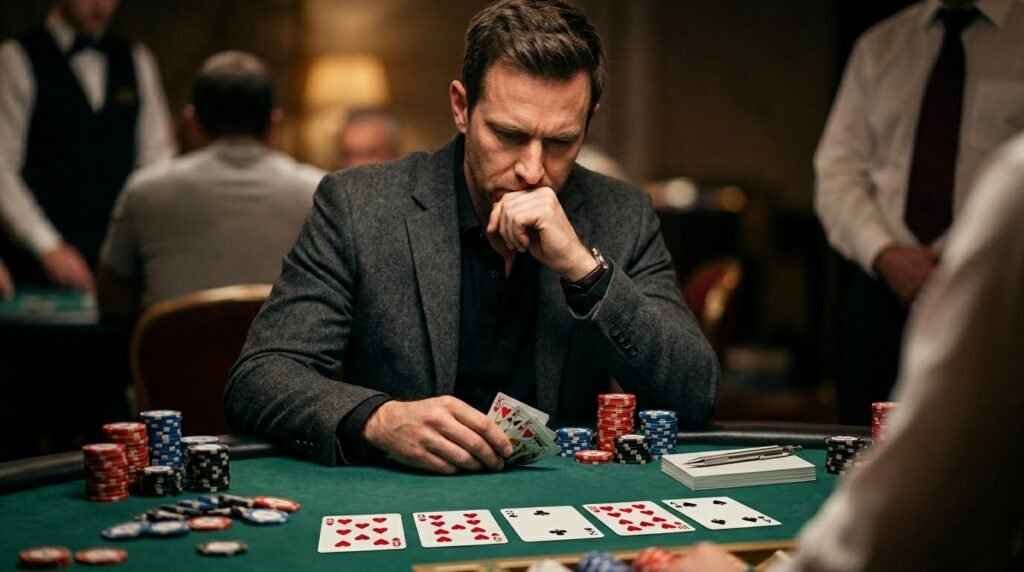
This isn’t complicated once you strip out the noise. Here’s the core process:
- Track exposed cards: Every card on the board and every card shown in a showdown is information. Note them — even mentally. If three hearts are on the board and you’ve seen two more hearts folded in earlier hands, the flush draw your opponent is chasing just got significantly less likely.
- Calculate your outs: An “out” is any card remaining in the deck that completes your hand. If you’re on an open-ended straight draw, you have eight outs by default. But if two of those cards were already mucked, you actually have six. That changes your pot odds calculation entirely.
- Estimate opponent ranges: Once you know what cards are gone, you can tighten the range of hands your opponent is likely holding. If you hold two aces and you’ve seen two more aces in folded hands during a multi-hand session, certain opponent bluffs become statistically more credible.
- Apply pot odds in real time: Take your outs, divide by the remaining deck size, compare to the pot odds being offered. If your equity percentage is higher than the percentage you’re being asked to call, you’re mathematically in profit. Card counting feeds directly into this calculation.
- Adjust for volatility: Not all drawing situations carry the same risk profile. High volatility spots — big pots, multiple players, uncertain ranges — need tighter counting discipline, not looser.
Here’s something most guides won’t tell you: the real advantage of practising card counting in poker isn’t the counting itself — it’s the mental habit of paying attention to every single card that hits the felt. Players who count cards don’t just count. They watch. That attention level alone separates them from the majority at the table.
Card Counting Benefits Most Players Completely Miss
Benefit 1: It Forces Better Hand-Reading
Most players focus on their own cards. Card counters, by habit, track everything — and that constant awareness forces more disciplined hand-reading. When you know what’s been removed from the deck, opponent hand ranges automatically narrow. You stop making calls based on gut and start making them based on what’s statistically plausible. Over a long session, that difference compounds.
Benefit 2: It Improves Your Bluff-Catching Instincts
Here’s something worth sitting with: if you track exposed cards well, you’ll notice moments when your opponent’s claimed hand is nearly impossible given what’s been dealt. A player representing a flush when four cards of that suit are already accounted for? The maths doesn’t support it. Card counting gives you a quiet edge in calling bluffs that most players would fold to.
Benefit 3: It Naturally Extends Your Table Attention Span
Players who practise counting develop an almost involuntary focus. You can’t zone out between hands if you’re tracking cards. That heightened attention catches tells, betting patterns, and timing tells that passive players completely miss. It’s not the counting itself that pays off — it’s the discipline it demands from you every hand.
Tips That Actually Work
Stop thinking in individual cards, start thinking in groups
Most players who try card counting in poker track specific cards — “the king of clubs came out” — which is exhausting and ultimately unnecessary. Instead, group by suit for flush draws and by rank bracket for straight draws. This cuts cognitive load by about half and keeps you functional across a long session.
Use multi-way pots as free information
Here’s something almost nobody talks about: multi-way pots are a goldmine for card counters. When five players see a flop, that’s potentially ten hole cards you can track over time through showdowns. The more hands you observe at a table, the more accurate your deck reconstruction becomes. Poker’s social format is a card counter’s natural advantage.
Keep a running mental tally of suit distribution, not just ranks
Most players track high cards at best. Tracking suit distribution — how many of each suit have appeared — is where flush draw reads get precise. It’s harder to do, but if you can manage it, you’ll spot flush-chasing bluffs earlier than anyone else at the table, and fold or call at exactly the right moments.
Treat counting as a warm-up skill, not an end goal
Card counting alone won’t win you pots. It feeds into a decision-making process. Players who make counting the whole game end up paralysed by probability instead of freed by it. Use your counts to inform ranges and odds, then let your read on the player finalize the decision. The maths is the foundation — the read is the structure you build on top.
Mistakes to Avoid With Card Counting in Poker
There are a few ways players consistently get this wrong.
Mistake 1: Applying blackjack counting systems to poker
What it is: Using Hi-Lo or similar blackjack counting systems at a poker table, assigning point values to cards and adjusting your wager accordingly.
Why players make it: The term “card counting” is so strongly associated with blackjack that players assume the mechanics are transferable.
How to avoid it: Understand that poker is a player-vs-player game. There’s no dealer hand to beat by shifting your wager. Track outs and equity — not a running count meant to time big bets against the casino.
Mistake 2: Ignoring folded cards as non-information
What it is: Mentally discarding all unseen folded cards instead of building probability estimates from showdowns and exposed mucked hands.
Why players make it: It feels like you can’t know what was folded, so players give up on that information entirely.
How to avoid it: Showdowns are your best friend. Every time cards are revealed at the end of a hand, update your mental model of the remaining deck. Over time, this compounds into significantly better range estimates.
Mistake 3: Over-counting at the expense of table awareness
What it is: Getting so focused on tracking cards that you miss betting patterns, timing tells, or position-based reads that would have guided better decisions.
Why players make it: Counting feels disciplined and mathematical — it’s easy to over-invest in it at the expense of softer reads.
How to avoid it: Card counting should take maybe 20% of your mental bandwidth. The rest belongs to the players. If you find yourself missing obvious behavioural signals, pull back on counting detail until you find a sustainable balance.
FAQs
What exactly is card counting in poker?
It’s the practice of tracking which cards have been exposed through the board and showdowns to calculate outs, estimate opponent hand ranges, and make more accurate probability-based decisions. It’s a legal mental discipline — not a device or system — and it’s completely different from blackjack card counting in both method and application.
How does card counting in poker work step by step?
You track exposed cards on the board and in showdowns, subtract them from the full deck, calculate how many cards complete your hand (outs), then compare that probability to the pot odds being offered. If your equity is higher than your call percentage, you’re in a profitable spot mathematically. It’s poker maths, done in real time.
Is card counting in poker actually worth learning?
For casual players, the return may not justify the mental effort. But for anyone playing regularly or wanting to move up in stakes, yes — absolutely. It sharpens hand-reading, improves pot odds decisions, and builds the kind of focused table attention that catches tells most players never notice. The skill scales with your ambition.
What are the biggest mistakes to avoid?
The two biggest: importing blackjack counting systems into poker (they don’t apply), and obsessing over counting to the point you miss obvious player behaviour. Card counting is a tool that feeds into decisions — it’s not the decision itself. Keep it in proportion and it becomes genuinely valuable.
What’s the single best tip for getting the most from card counting in poker?
Start with suit tracking in flush-heavy board textures. It’s the highest-impact, most immediately applicable version of the skill. When you can accurately assess how likely a flush draw is based on what’s been exposed, your river decisions — calls and folds — will immediately become more accurate. Build the habit there first.
Final Thoughts
The biggest thing to take away is that card counting poker is not a magic weapon — it’s a thinking habit. It works because it forces you to pay attention to information most players throw away, and because it connects your decisions to actual probability rather than instinct alone. Players who practise it consistently find that their reads improve, their pot odds decisions become cleaner, and their bluff-catching gets sharper — not because counting is some secret code, but because the discipline it demands bleeds into every other part of their game.
It’s also worth being honest: this isn’t a skill that turns a losing player into a winner overnight. It takes time to run card tracking and table reads simultaneously without losing either. Start small, work on one street at a time, and let the habit develop before you lean on it in high-pressure spots.
Card counting in poker rewards patience and attention — the same qualities that separate long-term winners from everyone else at the table.