Poker hand rankings in order, from weakest to strongest, are: High Card, Pair, Two Pair, Three of a Kind, Straight, Flush, Full House, Four of a Kind, Straight Flush, and Royal Flush. Rarer combinations always beat more common ones, regardless of card value.
Introduction
Two players stare at the same five community cards. One has a pair of kings. The other has three scattered low cards that somehow form a straight. Who wins? If you hesitated, you’re not alone — this mix-up happens at poker tables everywhere, every single day.
Understanding poker hand rankings in order isn’t about memorizing a chart and hoping for the best. It’s about knowing why a flush beats a straight, why rarity determines strength, and how to read the board fast enough to make confident decisions. By the end of this guide, you’ll know all ten hand rankings cold, understand the logic behind the order, and avoid the mistakes that trip up nearly every new player.
What Are Poker Hand Rankings and Why Do Beginners Struggle With Them?
Poker hand rankings are the fixed hierarchy that determines which five-card combination beats another. They exist so that no matter what game variant you’re playing — Texas Hold’em, Omaha, Seven-Card Stud — everyone agrees on what wins.
Beginners struggle for a simple reason: the rankings aren’t intuitive at first glance. It feels like three of a kind should obviously beat a straight, since you’re matching identical cards. But a straight requires five cards in sequence from four different suits, which is statistically harder to land. Poker hand rankings follow probability, not gut feeling.
There’s also confusion between hand category and hand rank within that category. Two players can both hold a flush, but the one with the higher top card wins. That distinction alone causes more table disputes than almost anything else in the game.
Pro Tip: Rarity determines strength. Whenever you’re unsure which hand wins, ask yourself which combination is statistically harder to make — that’s usually your answer.
The 10 Poker Hand Rankings In Order (Weakest to Strongest)
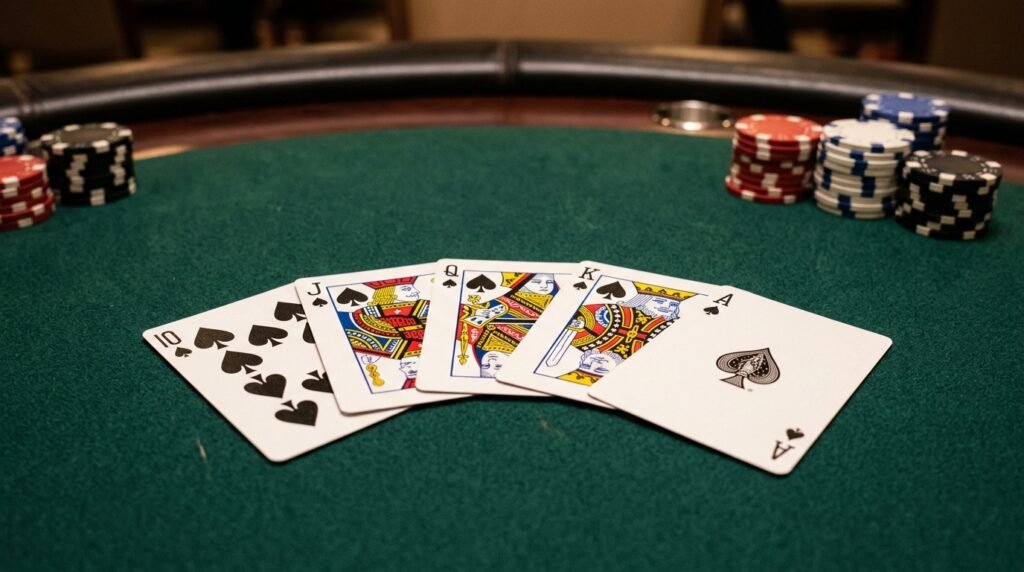
Here’s the full hierarchy, numbered from lowest to highest:
- High Card – No matching cards or sequence; the highest single card plays.
- Pair – Two cards of the same rank.
- Two Pair – Two separate pairs plus one additional card.
- Three of a Kind – Three cards of the same rank.
- Straight – Five cards in sequential order, mixed suits.
- Flush – Five cards of the same suit, not in sequence.
- Full House – Three of a kind plus a pair.
- Four of a Kind – Four cards of the same rank.
- Straight Flush – Five sequential cards, all the same suit.
- Royal Flush – A-K-Q-J-10, all the same suit — the rarest hand in poker.
Each step up this list represents a combination that’s mathematically harder to form. That’s the entire logic behind the order — nothing more mysterious than probability.
How Hand Rankings Actually Work at the Table
Knowing the list is one thing. Understanding how it plays out with real cards is another.
In community card games like Texas Hold’em, you form your best five-card hand using any combination of your two hole cards and the five shared board cards. The game doesn’t care how you got there — only which five cards, when combined, rank highest.
Here’s where it gets practical: two players can hold different hole cards but end up with the same hand type. If both have a flush, the tiebreaker becomes the highest card within that flush. If those match too, you move to the next-highest card, and so on, until someone’s hand pulls ahead.
This is called “kicker” logic, and it trips up more beginners than the base rankings themselves. A pair of aces with a king kicker beats a pair of aces with a queen kicker — same pair, different supporting card.
Common Mistakes Beginners Make With Hand Rankings
New players tend to repeat the same handful of errors:
- Overvaluing a flush draw. Having four cards to a flush isn’t a flush yet — it’s a possibility, not a made hand.
- Forgetting suits don’t rank against each other. A flush in hearts doesn’t beat a flush in spades. Only card values matter for ties.
- Confusing a straight’s ace flexibility. An ace can play high (10-J-Q-K-A) or low (A-2-3-4-5), but never both in the same hand — “wraparound” straights like Q-K-A-2-3 don’t exist.
- Misjudging full house strength. Between two full houses, the three-of-a-kind portion determines the winner first, not the pair.
Pro Tip: Before assuming you have the winning hand, mentally rebuild your best five-card combination from scratch. It’s easy to overestimate a hand when you’re excited about a good flop.
Poker Terminology You Need to Know
A few terms show up constantly once you start discussing hand rankings:
- Kicker – The unused card(s) that break ties between identical hand types.
- Board – The community cards shared by all players.
- Nuts – The best possible hand available given the current board.
- Made hand – A complete hand you currently hold, as opposed to a draw.
- Draw – An incomplete hand that needs specific future cards to improve.
- Kickers play – A phrase used when a hand is decided by kicker comparison rather than the main hand type.
Learning this vocabulary makes it far easier to follow strategy discussions, understand table talk, and read further guides without constantly pausing to look things up.
Strategy Tips for Understanding Hand Strength
You don’t need to memorize odds tables to build strong instincts. Start with these habits:
First, practice identifying your best five-card hand out loud, especially in community card games where it’s easy to misread your options. Second, pay attention to how the board texture changes hand strength — a flush becomes far less special once three of the same suit are sitting in the middle of the table, since anyone could have it.
Third, get comfortable with the idea that hand rankings are relative, not absolute. A pair might be the best hand at one table and worthless at another, depending on what’s visible on the board.
Pro Tip: Watch the community cards as closely as your own hole cards. The board tells you what’s possible for your opponents, not just what’s possible for you.
Myths vs. Facts About Poker Hand Rankings
Myth: Suits have a ranking order (spades beat hearts, etc.)
Fact: No standard poker variant ranks suits. Ties by suit simply split the pot.
Myth: A five-card straight always beats three of a kind by a wide margin.
Fact: True, but the margin in real-world frequency is smaller than most beginners assume — both are relatively rare in a full deck.
Myth: Four of a kind is the best possible hand.
Fact: It’s strong, but both straight flushes and royal flushes rank higher.
Myth: You need all five of your own cards to make a hand.
Fact: In community card games, you can use zero, one, or two of your hole cards combined with the board.
Comparison Table: Poker Hand Rankings and Approximate Odds
| Hand Ranking | Description | Approximate Odds (5-card draw) |
|---|---|---|
| Royal Flush | A-K-Q-J-10, same suit | 1 in 649,740 |
| Straight Flush | 5 sequential, same suit | 1 in 72,193 |
| Four of a Kind | 4 matching ranks | 1 in 4,165 |
| Full House | 3 of a kind + pair | 1 in 694 |
| Flush | 5 same suit, mixed order | 1 in 509 |
| Straight | 5 sequential, mixed suits | 1 in 255 |
| Three of a Kind | 3 matching ranks | 1 in 47 |
| Two Pair | 2 separate pairs | 1 in 21 |
| Pair | 2 matching ranks | 1 in 2.4 |
| High Card | No matching combination | Most common outcome |
Conclusion
Poker hand rankings in order come down to one core idea: rarity equals strength. The harder a combination is to form, the higher it sits on the list — from a simple high card all the way up to the elusive royal flush. Keep three things in mind as you keep learning: rankings are based on probability, kickers break ties within the same hand type, and suits never outrank each other.
So next time you’re looking at a board full of community cards, can you spot your best five-card hand without hesitating? If you want to build on this foundation, a guide to starting hand selection is a natural next step. Master the order, and everything else about the game starts to make a lot more sense.
FAQs
What are poker hand rankings in order from best to worst?
From strongest to weakest: Royal Flush, Straight Flush, Four of a Kind, Full House, Flush, Straight, Three of a Kind, Two Pair, Pair, and High Card. Each ranking beats every hand below it regardless of the actual card values involved, since the hierarchy is based on how statistically rare each combination is to form.
Does a flush beat a straight in poker?
Yes. A flush always beats a straight because five cards of the same suit are statistically harder to form than five sequential cards of mixed suits. This holds true across all standard poker variants, including Texas Hold’em, Omaha, and Seven-Card Stud, with no exceptions.
What beats a full house in poker hand rankings?
Only three hands beat a full house: Four of a Kind, Straight Flush, and Royal Flush. Here’s the quick order above it:
- Four of a Kind
- Straight Flush
- Royal Flush
Everything else, including a flush or straight, ranks below a full house.
Can two players have the same poker hand ranking?
Yes, and it happens often. When this occurs, the tiebreaker moves to the highest card within the hand, then the next-highest, and so on — this is called comparing “kickers.” If every card matches exactly, the pot is split between the tied players.
Is an ace high or low in poker hand rankings?
An ace can play as the highest card (above a king) or the lowest card (below a 2) when forming a straight, but never both simultaneously. This means A-2-3-4-5 is a valid straight, and so is 10-J-Q-K-A, but Q-K-A-2-3 is not.
What is the rarest hand in poker hand rankings?
The Royal Flush is the rarest, requiring A-K-Q-J-10 all in the same suit. The odds of being dealt one in a five-card draw are roughly 1 in 649,740, making it far rarer than any other hand on the ranking list, including a standard straight flush.