In poker, starting chip counts depend on the game type. Cash games typically start with 40–100 big blinds (buy-in dependent), while tournaments usually start with 1,500–50,000 chips depending on the format. Home games often use a flat number like 500 or 1,000 chips per player, regardless of blind size.
Introduction
Sit down at two different poker tables and you might get two wildly different chip stacks — one player gets 1,500 chips, another gets 20,000. Neither is wrong. So how many chips do you start with in poker, exactly? The honest answer is: it depends entirely on which format you’re playing. Cash games, tournaments, and home games each follow their own conventions, and understanding these differences will save you from confusion (and awkward questions) the first time you sit down to play. In this guide, you’ll learn exactly how starting stacks are determined, why the numbers vary so much, and how to make sense of chip values before you ever place a bet.
What Determines Your Starting Chip Count (And Why Beginners Get Confused)
Beginners often assume there’s one universal number for starting chips. There isn’t. The starting stack in poker is tied to three separate factors: the format of the game, the buy-in amount, and the blind structure being used.
In a cash game, chips represent real monetary value — a $100 buy-in might get you exactly 100 chips worth $1 each, or a mix of denominations totaling $100. In a tournament, chips are a scorekeeping tool. A $50 tournament buy-in might hand you 10,000 chips, while a $500 buy-in at a different tournament might also give 10,000 chips. The dollar value isn’t printed on the chip — it’s an abstraction used purely to track your position in the event.
This distinction confuses new players because they assume more chips automatically means more money on the table. It doesn’t. What matters is chip count relative to the blinds, not the raw number itself.
Standard Starting Stacks: Step-by-Step Breakdown
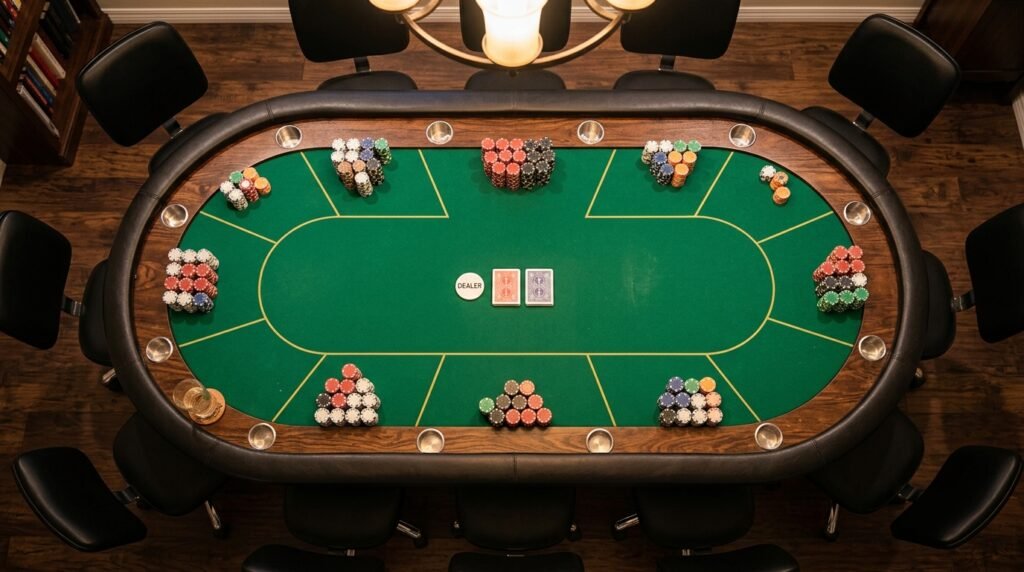
Here’s how starting chip amounts typically break down across common formats:
- Cash games: Minimum buy-in is often 40 big blinds, with a maximum around 100–200 big blinds. At a $1/$2 table, that’s a $40–$400 range.
- Live tournaments: Standard buy-ins usually start players with 10,000–30,000 chips, with blinds beginning very low relative to the stack.
- Online tournaments: Often start smaller, around 1,500–3,000 chips, since blind levels increase quickly.
- Deep-stack tournaments: Can start players with 50,000+ chips, designed to slow the pace of eliminations.
- Home games: Hosts often assign a flat amount — commonly 500 or 1,000 chips per player — split across a few denominations for simplicity.
- Freeroll tournaments: Frequently start with a modest 1,000–1,500 chips since the entry cost is zero and fast-paced play is expected.
The common thread: the number itself is meaningless without knowing the blind levels attached to it.
How Starting Stacks Actually Work in Practice
The relationship between your chip count and the blinds is what actually matters. This is usually expressed as your stack measured in “big blinds” (BB).
If you start a tournament with 20,000 chips and blinds of 100/200, you have 100 big blinds — a very healthy stack with room to maneuver. If another tournament starts you with 20,000 chips but blinds of 500/1,000, you only have 20 big blinds — a much shorter stack requiring tighter decisions early on.
This is why comparing chip counts across different tables or tournaments is misleading unless you also compare blind structures. A “big” stack in one event might be a “short” stack in another.
Pro Tip: Always check the blind schedule before judging whether your starting stack is big or small — the chip number alone tells you almost nothing.
Common Beginner Mistakes With Starting Chips
New players tend to make the same handful of errors when it comes to understanding chip counts:
- Assuming chip value is fixed. In tournaments, chips have no cash value outside the event — they can’t be cashed out for their face number.
- Ignoring blind levels. Focusing only on the chip count without checking how fast blinds increase leads to poor stack management decisions.
- Confusing rebuy and starting stack rules. Some tournaments allow rebuys that reset or add to your stack; not knowing this can cause a player to play too conservatively or too loosely.
- Misjudging table position from stack size alone. A short stack isn’t automatically a weak position — sometimes it forces sharper, more effective decisions.
- Not asking the dealer or host for a chip value breakdown. In home games especially, denominations vary widely, and guessing can lead to real confusion mid-hand.
Key Terms You Need to Know
A few terms come up constantly when discussing starting chips:
- Big blind (BB): The larger of the two forced bets; used as the standard unit for measuring stack size.
- Buy-in: The amount of money exchanged for your starting chip stack.
- Rebuy/Re-entry: The option in some tournaments to purchase additional chips after losing your stack, usually within a set period.
- Chip denomination: The face value assigned to each chip color (e.g., white = 1, red = 5, blue = 10).
- Ante: A smaller forced bet, separate from blinds, sometimes added to stacks later in tournaments to speed up play.
- Stack depth: A description of how many big blinds a player holds relative to the current blind level.
Knowing these terms helps you interpret any chip count you’re handed, no matter the format.
Understanding Stack Size: Tips for Beginners
Rather than memorizing specific numbers, focus on understanding stack size in relative terms. A useful mental framework:
- Under 15 big blinds is generally considered a short stack, where decisions become simpler and more binary.
- 20–50 big blinds is a mid stack, requiring more nuanced decision-making.
- Over 50 big blinds is a deep stack, allowing for more complex, multi-street strategies.
Pro Tip: When you sit down at any table, do a quick mental calculation of your big blind count before playing a single hand — it reframes how you should be thinking about the entire session.
This framework applies whether you’re holding 1,500 chips or 150,000 — it’s the ratio, not the raw number, that shapes decision-making.
Myths vs. Facts About Starting Chips
| Myth | Fact |
|---|---|
| More starting chips means a bigger advantage | Chip value is relative to blinds, not absolute |
| Every tournament starts players with the same chip count | Starting stacks vary widely by tournament structure |
| Chips in a tournament represent real cash value | Tournament chips are only tracking tools, not currency |
| Cash game chips and tournament chips work the same way | Cash chips hold direct monetary value; tournament chips do not |
| A short stack means you’re losing | Stack depth is relative to blind level, not a fixed measure of standing |
Comparison Table: Starting Chip Counts by Format
| Format | Typical Starting Chips | Typical Blind Start | Notes |
|---|---|---|---|
| Cash game | Buy-in dependent (40–100 BB) | Fixed, doesn’t increase | Chips = real money |
| Live tournament | 10,000–30,000 | Low relative to stack | Blinds increase on a timer |
| Online tournament | 1,500–3,000 | Increases quickly | Faster-paced structure |
| Deep-stack event | 50,000+ | Very low relative to stack | Designed for longer play |
| Home game | 500–1,000 (flat) | Host-determined | Denominations vary by set |
| Freeroll | 1,000–1,500 | Increases rapidly | No monetary buy-in |
Conclusion
Understanding how many chips you start with in poker comes down to three things: the format you’re playing, the buy-in structure, and how that stack compares to the blinds. Cash games tie chips directly to money, tournaments use them as a scoring tool, and home games often just pick a convenient flat number. Once you stop focusing on the raw chip count and start thinking in terms of big blinds, the entire game becomes far easier to read.
So next time you sit down at a table, ask yourself: how many big blinds do I actually have to work with? For a deeper look at how blind structures evolve over a tournament, check out our guide on poker blind schedules explained.
Chips may just be plastic discs, but understanding what they represent is where real poker literacy begins.
FAQ
How many chips do you start with in poker tournaments?
Tournament starting stacks vary by format, typically ranging from 1,500 chips in fast online events to 30,000 or more in live deep-stack tournaments. The exact number depends on the buy-in and structure set by the tournament organizer, so it’s worth checking the specific event’s rules before you register or sit down to play.
How many chips do you start with in a home poker game?
Home games commonly use a flat starting amount, often 500 or 1,000 chips per player, split across a few denominations for simplicity. Here’s a typical home game breakdown:
- White chips = 1 point
- Red chips = 5 points
- Blue chips = 10 points
The exact split depends entirely on what the host decides.
Do all poker players start with the same number of chips?
Within a single tournament or organized cash game, yes — all players typically start with equal chip counts to keep the game fair. However, starting counts differ significantly between different tournaments, cash games, and home games, so there’s no universal number across poker as a whole.
What happens if you run out of starting chips?
In cash games, you can typically buy more chips to continue playing. In tournaments, this depends on the rules: some allow rebuys or re-entries during a set period, while others are single-elimination, meaning you’re finished once your stack reaches zero.
How many chips do you start with compared to the blinds?
This ratio, called your stack depth, matters more than the raw chip count. A 20,000-chip stack could be considered deep or short depending on whether blinds start at 25/50 or 500/1,000, so always compare your chips to the blind level, not just the number alone.
Why do tournament chips have no cash value?
Tournament chips exist purely to track a player’s position in the event, not to represent spendable money. This is different from cash game chips, which correspond directly to real currency and can typically be exchanged back for cash when you leave the table.