To shuffle cards like a pro, master the riffle shuffle by splitting the deck evenly, interleaving the cards with your thumbs, and squaring the deck cleanly. Practice slowly before speeding up, and always cut the deck afterward for better randomization.
Most people shuffle cards the same clumsy way they learned as kids — and never realize there’s an actual skill behind it. Learning how to shuffle cards like a pro isn’t about flashy casino tricks; it’s about control, consistency, and making sure every hand is genuinely random. Whether you’re hosting game night or just want your riffle shuffle to look less like a toddler dropped a deck of playing cards, this guide breaks the process down into steps anyone can follow.
By the end of this article, you’ll understand the main shuffling techniques, the mechanics behind why they work, common mistakes that ruin a shuffle, and how to practice until it feels natural.
What Is Card Shuffling and Why Beginners Struggle With It
Shuffling is simply the act of randomizing a deck of cards so no player can predict the order. It sounds basic, but there’s a reason most beginners fumble it — shuffling well requires coordination between both hands, consistent pressure, and a bit of muscle memory.
Beginners typically struggle because they try to copy a fast, flashy shuffle before understanding the fundamentals. They rush the riffle, apply uneven pressure, or grip the deck too tightly. The result is cards flying everywhere, an uneven split, or a shuffle that doesn’t actually randomize the deck at all.
Understanding the mechanics first — then practicing slowly — is what separates a smooth, professional-looking shuffle from a chaotic mess.
Rules and Steps: How to Shuffle Cards Like a Pro
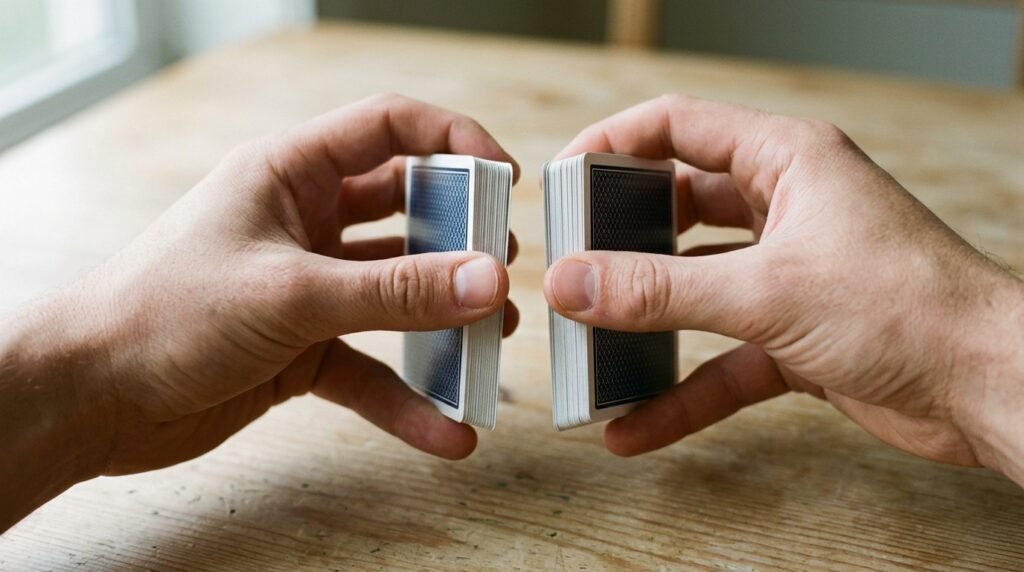
Here’s a simple step-by-step breakdown of the riffle shuffle, the most common technique used by dealers and card players:
- Split the deck into two roughly equal halves, holding one in each hand.
- Place your thumbs on the short edge of each half, facing each other.
- Bend each half slightly with your thumbs to create tension.
- Release the cards gradually, letting them interleave one at a time.
- Once fully riffled, push the two halves together gently.
- Square the deck by tapping the edges against a flat surface.
- Optionally, perform a bridge or waterfall finish for a smoother, more even mix.
- Repeat the process two to three times for better randomization.
Following these steps in order — without rushing — is the fastest way to build reliable shuffling habits.
How the Shuffle Actually Works (The Mechanics)
A shuffle works by breaking up the existing sequence of cards and reordering them unpredictably. When you riffle two halves together, you’re interleaving cards from each pile in a semi-random pattern determined by how quickly you release them from your thumbs.
The tighter and more even your interleaving, the more thoroughly the deck mixes. Professionals often combine multiple shuffling methods — like a riffle followed by a cut — because a single shuffle rarely randomizes a deck completely. Research on card shuffling mechanics has shown that it typically takes around seven riffle shuffles to fully randomize a standard 52-card deck.
This is why casual players who shuffle once or twice often end up with cards still clustered in a predictable order.
Pro Tip: Shuffle at least three to four times in a row if you want a genuinely random deck, especially before games where card order matters.
Common Beginner Mistakes to Avoid
Most shuffling problems come down to a handful of repeated errors:
- Gripping too hard, which makes cards bend or crease instead of flowing smoothly.
- Uneven splits, where one half has significantly more cards than the other.
- Rushing the interleave, causing clumps of cards to fall together instead of alternating.
- Skipping the square-up step, leaving cards misaligned before the next deal.
- Shuffling on an uneven surface, which throws off your control entirely.
Slowing down and focusing on consistency — rather than speed — fixes almost all of these issues within a few practice sessions.
Key Terms and Terminology Explained
Understanding shuffle-related vocabulary makes it easier to follow tutorials and card game rules:
- Riffle shuffle – interleaving two halves of the deck by releasing cards from each thumb.
- Overhand shuffle – transferring small packets of cards from one hand to the other repeatedly.
- Cut – dividing the deck into two stacks and swapping their order.
- Bridge/waterfall – a flourish where cards are bent and released to fall together smoothly.
- Square – aligning all cards evenly after shuffling.
- Wash (or scramble) – spreading cards face-down on a table and mixing them by hand.
Knowing these terms helps you follow more advanced tutorials without getting lost in unfamiliar jargon.
Strategy and Tips for Better Understanding
Improving your shuffle isn’t about performing tricks — it’s about developing consistent, repeatable motion. A few things that help:
- Practice with an old, slightly worn deck first, since new cards are stiffer and harder to control.
- Shuffle over a table or soft surface to catch dropped cards without damaging them.
- Break the riffle into slow motion repeatedly before attempting full speed.
- Combine shuffle types — for example, a wash followed by two riffles — for more thorough randomization.
- Watch your hand position in a mirror or on video to spot uneven pressure.
Pro Tip: Record yourself shuffling in slow motion. It’s the easiest way to spot exactly where your technique breaks down.
Myths vs. Facts About Shuffling
| Myth | Fact |
|---|---|
| One shuffle is enough to randomize a deck | It typically takes multiple riffle shuffles to fully randomize 52 cards |
| Faster shuffling means better randomization | Speed matters less than technique and repetition |
| Overhand shuffling is just as effective as riffling | Riffle shuffles generally mix cards more thoroughly than overhand shuffles |
| Shuffling tricks require special equipment | Most techniques only require standard playing cards and practice |
| A messy-looking shuffle means the deck is well mixed | Visual chaos doesn’t equal true randomization — consistent technique does |
Comparison Table: Common Shuffling Techniques
| Technique | Difficulty | Randomization Quality | Best For |
|---|---|---|---|
| Riffle shuffle | Medium | High | Most card games |
| Overhand shuffle | Easy | Low–Medium | Casual play, quick mixing |
| Wash/scramble | Easy | High | Starting a fresh game |
| Hindu shuffle | Medium | Medium | One-handed control |
| Bridge/waterfall finish | Hard | N/A (visual flourish) | Style, not randomization |
Final Thoughts
Learning how to shuffle cards like a pro comes down to three things: understanding the mechanics, practicing the riffle shuffle slowly before speeding up, and combining techniques for genuine randomization. Once the motion becomes automatic, your shuffle will look clean, controlled, and confident — no flashy tricks required.
Want to build on this foundation? Consider reading up on basic card game rules next, so you understand not just how to shuffle, but how that shuffled deck gets used in actual gameplay.
So — ready to put down the deck and start practicing, or are you still working on that first clean riffle?
FAQs
How many times should you shuffle a deck of cards?
Most experts recommend shuffling a standard 52-card deck around seven times using the riffle method to achieve genuine randomization. Fewer shuffles often leave cards clustered in patterns similar to their original order, especially in games where sequence matters, like blackjack or poker.
What is the easiest way to shuffle cards like a pro?
The riffle shuffle is the most reliable technique to practice. Break it into these steps: 1) split the deck evenly, 2) interleave the cards slowly, 3) square the deck, and 4) repeat several times. Starting slowly builds the muscle memory needed for a clean, professional-looking result.
Why does my shuffle keep bending or damaging the cards?
This usually happens from gripping the deck too tightly or applying uneven pressure during the riffle. Loosen your grip, use a worn-in deck while practicing, and let the cards fall naturally instead of forcing them together.
What’s the difference between a riffle shuffle and an overhand shuffle?
A riffle shuffle interleaves two halves of the deck for thorough mixing, while an overhand shuffle transfers small packets of cards repeatedly. The overhand method is easier to learn but generally produces weaker randomization compared to riffling.
Can you shuffle cards like a pro without special equipment?
Yes. All you need is a standard deck of playing cards and a flat surface to practice on. Professional-looking shuffles come from technique and repetition, not special tools or expensive decks.
Is there a faster way to learn how to shuffle cards like a pro?
Practicing in slow motion, then gradually increasing speed, is faster long-term than trying to shuffle quickly from the start. Recording yourself and comparing your hand position to tutorials also speeds up the learning curve significantly.