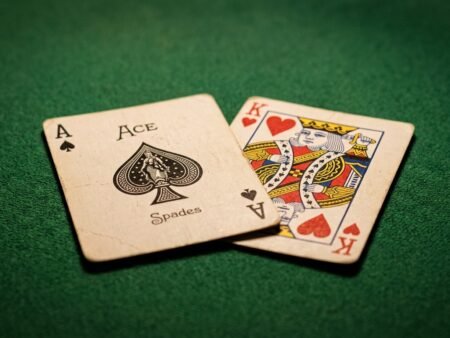
In blackjack, number cards count at face value (2–10), face cards (Jack, Queen, King) are worth 10, and Aces count as either 1 or 11 — whichever helps your hand more. Getting these values right is the foundation of playing blackjack with confidence.
Introduction
Ask ten beginners what a Jack is worth in blackjack, and you might get ten different answers. Some think face cards have special powers. Others assume the Ace always counts as 11. Neither is true, and that confusion is exactly why so many new players hesitate at the table.
Blackjack card values explained the right way are simple: every card has a fixed number attached to it, except one. That single exception — the Ace — is what makes the game interesting, and it’s also where most beginners trip up.
In this guide, you’ll learn exactly what each card is worth, how totals are calculated, why the Ace is so flexible, and which mistakes to avoid as you’re learning. By the end, you won’t just know the numbers — you’ll understand how they fit together.
What Are Blackjack Card Values, and Why Do Beginners Struggle With Them?
Blackjack is a card game built entirely around one goal: get your hand’s total as close to 21 as possible without going over. That means every card needs a clear numerical value, and blackjack’s system is actually more straightforward than most casino games.
So why do beginners still get tripped up? A few reasons come up again and again.
First, people assume face cards carry different values from each other. They don’t. A King, Queen, and Jack are all worth exactly the same amount. Second, new players often think the Ace is locked at either 1 or 11, when really it shifts depending on what’s best for the hand. Third, the term “blackjack” itself gets confused with just any high-scoring hand, when it actually refers to one very specific combination.
Once you separate these three points, the card values stop feeling mysterious and start feeling like basic arithmetic.
Blackjack Card Values: Step-by-Step Rules
Here’s the complete breakdown, laid out simply:
- Number cards (2 through 10) count at their exact face value. A 7 is worth 7 points, a 4 is worth 4 points, and so on.
- Face cards — Jack, Queen, and King — are all worth exactly 10 points each, regardless of suit.
- The Ace counts as either 1 or 11, and you choose whichever value keeps your hand alive or closer to 21.
- Suits don’t matter. A hand of hearts isn’t worth more than a hand of clubs. Only the numbers count.
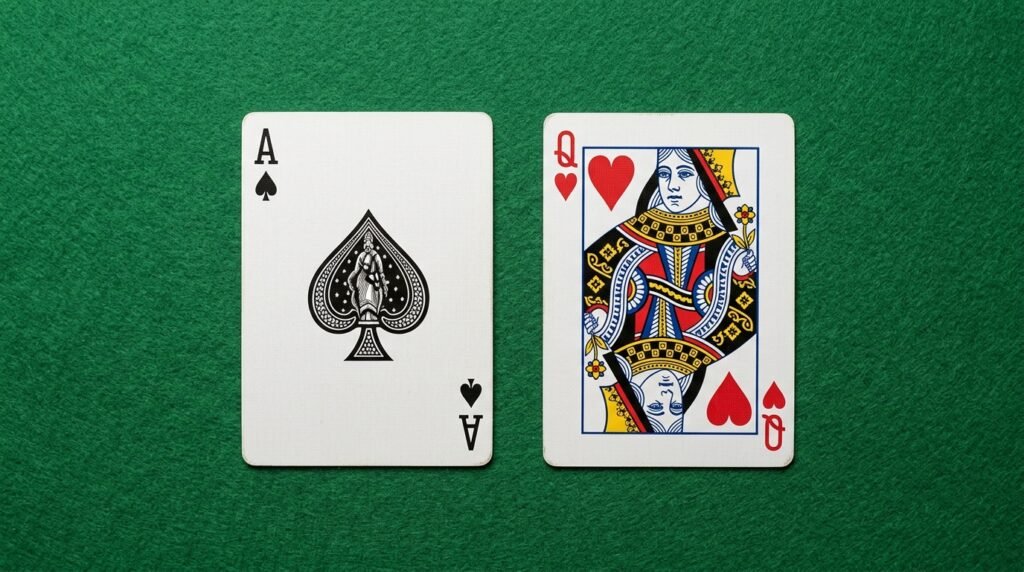
- A “blackjack” happens when your first two cards are an Ace plus any 10-value card (a 10, Jack, Queen, or King), totaling exactly 21.
- Going over 21 at any point means you “bust,” and the hand is over regardless of what happens next.
- Ties on total value (called a “push”) return the wager without a win or loss.
Once you memorize these seven points, you’ve essentially learned the entire scoring system.
How the Scoring Actually Works in Practice
Knowing the individual values is one thing. Watching them work together in a real hand is where it clicks.
Say you’re dealt a 9 and a King. That’s 9 + 10, giving you a hand total of 19 — a strong position without needing to draw another card. Now imagine you’re dealt an Ace and a 6. Counted as 11, the Ace gives you a “soft 17” (11 + 6), which is flexible because if you draw a card that would push you over 21, the Ace simply drops to a value of 1 instead.
This flexibility is why blackjack hands are described as “soft” or “hard.” A soft hand contains an Ace counted as 11 with room to adjust. A hard hand either has no Ace or one that’s already forced to count as 1 because the alternative would bust the hand.
Pro Tip: When you see “soft 16” or “soft 18” mentioned in strategy charts, it always means an Ace is involved. Recognizing this instantly tells you the hand has built-in flexibility.
Common Beginner Mistakes With Card Values
Even players who know the basic numbers still make errors early on. Here are the most frequent ones.
Mistake 1: Assuming face cards have different point values. A Queen isn’t worth more than a Jack. They’re identical at 10 points each.
Mistake 2: Forgetting the Ace can drop to 1. New players sometimes panic when they draw a card that seems to bust their hand, not realizing the Ace automatically adjusts.
Mistake 3: Confusing “blackjack” with any 21. If you build a 21 across three or more cards, it’s a strong hand, but it isn’t the same as a two-card blackjack, and payouts can differ between the two.
Mistake 4: Miscounting multi-card hands under pressure. Adding up four or five cards quickly takes practice. Slowing down avoids costly errors.
Mistake 5: Ignoring suit irrelevance. Some beginners instinctively feel a hand of matching suits should be worth more. It isn’t — suits play no role in scoring at all.
Blackjack Terminology You Should Know
Understanding card values gets easier once the surrounding vocabulary makes sense.
- Hard hand: A hand with no Ace, or an Ace forced to count as 1.
- Soft hand: A hand containing an Ace still flexible between 1 and 11.
- Bust: Any hand total exceeding 21, resulting in an automatic loss.
- Push: A tie between your hand and the dealer’s, where your wager is simply returned.
- Natural (or Blackjack): A two-card hand totaling exactly 21 using an Ace and a 10-value card.
- Stand: Choosing to keep your current total without drawing further cards.
- Hit: Requesting an additional card to try to improve your total.
Learning these terms alongside the number values means you’ll actually understand strategy charts and rule explanations the first time you see them, instead of having to decode them.
Tips for Understanding Card Values More Intuitively
Memorizing numbers is one thing; internalizing them so they feel automatic takes a bit more repetition. These approaches help.
Group cards by value first. Instead of memorizing 13 individual cards, remember there are really only two categories to learn: cards worth their number (2–10) and cards worth exactly 10 (J, Q, K). The Ace is the only true outlier.
Practice mental addition with pairs. Pick two random cards and add them mentally before checking. Repetition here builds speed faster than reading alone.
Say totals out loud when studying. Verbalizing “9 plus King is 19” reinforces memory more effectively than silent reading.
Pro Tip: Try picturing every face card as a “perfect 10” — that single mental shortcut removes almost all confusion around Jacks, Queens, and Kings.
Use a reputable rules reference while learning. Cross-checking your understanding against a trusted source helps catch small misunderstandings early.
Blackjack Card Value Myths vs. Facts
| Myth | Fact |
|---|---|
| Face cards have different point values | All face cards (J, Q, K) are worth exactly 10 |
| The Ace is always worth 11 | The Ace can count as 1 or 11, whichever suits the hand |
| A three-card 21 is the same as a “blackjack” | Only a two-card Ace + 10-value combination counts as a natural blackjack |
| Suits affect scoring | Suits have zero impact on card value or hand strength |
| Higher totals always mean a better hand | Totals above 21 bust automatically, regardless of how “high” they seem |
Comparing Blackjack Card Values Across Common Variations
Most blackjack variations share the same core value system, but small rule differences affect how those values play out.
| Variation | Card Value System | Notable Difference |
|---|---|---|
| Classic Blackjack | Standard (2–10 face value, J/Q/K = 10, Ace = 1/11) | Baseline rules most guides reference |
| European Blackjack | Standard | Dealer typically draws only one card initially |
| Spanish 21 | Standard, but 10s removed from the deck | Fewer high-value cards changes hand frequency |
| Multi-Hand Blackjack | Standard | Same values apply across multiple simultaneous hands |
Even with variation-specific rule tweaks, the fundamental card values explained above stay consistent across nearly every version you’ll encounter.
Conclusion
Blackjack card values aren’t complicated once you strip away the confusion: number cards count at face value, face cards are all worth 10, and the Ace flexibly shifts between 1 and 11 depending on what your hand needs. Suits never factor into scoring, and a true “blackjack” only happens with a two-card Ace-plus-10 combination.
With these fundamentals down, the rest of the game becomes far easier to follow — strategy charts make sense, dealer rules click into place, and you can follow a hand in real time without hesitating over the math.
Curious how these values connect to actual decision-making at the table? A guide on basic blackjack strategy is a natural next step.
Understanding the numbers is easy. Understanding what to do with them is where the real game begins.
FAQs
What is the value of an Ace in blackjack?
An Ace can count as either 1 or 11 points, and the player (or dealer, following house rules) chooses whichever value benefits the hand most. This flexibility is what makes hands “soft,” since the total can adjust automatically if drawing another card would otherwise cause a bust.
Are Jack, Queen, and King worth different amounts in blackjack?
No. All three face cards — Jack, Queen, and King — are worth exactly 10 points each in blackjack card values. There’s no distinction between them based on rank or suit; they’re treated identically for scoring purposes throughout the entire game.
What are the basic blackjack card values beginners should memorize?
There are really just three groups to remember:
- Number cards (2–10) equal their face value.
- Face cards (J, Q, K) are each worth 10.
- The Ace counts as 1 or 11, whichever fits the hand.
That’s the entire scoring system in three points.
Does suit affect blackjack card values?
No, suits (hearts, diamonds, clubs, spades) have absolutely no effect on card value or hand strength in blackjack. Only the number or rank of the card matters for scoring. This differs from some other card games where suits carry importance.
What happens if my hand goes over 21?
Going over 21 is called “busting,” and it results in an automatic loss regardless of what the dealer’s hand ends up being. This is why understanding blackjack card values — especially how the Ace adjusts — is so important for avoiding unnecessary busts.
What’s the difference between a soft hand and a hard hand?
A soft hand includes an Ace still counted as 11, giving it flexibility to absorb another card without busting. A hard hand either has no Ace or one already forced down to a value of 1. Recognizing which type you’re holding is key to understanding strategy charts.