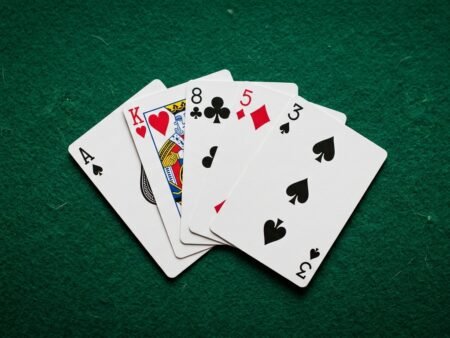
Picture this: you’re three hours into a home game in your buddy’s garage, there’s $60 in the pot, and the board shows two pair. You’re holding a pocket pair that gives you a full house, but for a solid five seconds you genuinely can’t remember if that beats a flush or loses to it. Your friends are staring. The clock isn’t literally ticking, but it feels like it is.
I’ve seen this exact scenario play out more times than I can count — not just at kitchen tables, but at real casinos too. Even players who’ve been at it for a year sometimes freeze on the finer points of hand rankings, especially when two hands look deceptively close in strength. This guide exists to kill that hesitation for good. Below, you’ll get the full poker hand rankings chart from top to bottom, the actual math behind why the order is what it is, the mistakes I see beginners make constantly, and answers to the questions people search for most.
The Full Poker Hand Rankings Chart, Best to Worst
This ranking system applies to virtually every mainstream variant you’ll encounter in the U.S. — Texas Hold’em at the Borgata, Omaha Hi-Lo at a home game, or a cash table on WSOP.com. Here’s the order, strongest to weakest:
- Royal Flush — A, K, Q, J, 10, all one suit. The rarest hand in poker. Some players go their entire careers without ever holding one live.
- Straight Flush — Five sequential cards, same suit. Say, 5-6-7-8-9 of spades.
- Four of a Kind — Four cards sharing a rank, like all four 10s.
- Full House — Three of a kind plus a separate pair. Three 8s and two kings, for instance.
- Flush — Five cards, one suit, not in order.
- Straight — Five sequential cards, mixed suits.
- Three of a Kind — Three cards of matching rank.
- Two Pair — Two different pairs plus a kicker card.
- One Pair — Two matching cards.
- High Card — Nobody’s got a made hand, so the highest single card takes it.
Save that list, screenshot it, whatever gets it in front of your eyes during a session. But here’s my honest take: staring at a chart only gets you so far. The players who never hesitate are the ones who’ve played it out at the table enough times that the order becomes muscle memory. Give it three or four real sessions and you won’t need the cheat sheet anymore.
Why Does a Flush Beat a Straight? (The Question I Get Asked Most)

This one trips up more people than anything else on the list, and honestly, it makes sense why. A straight feels like it should be harder — the cards have to land in perfect numerical order. But poker rankings aren’t based on gut feeling, they’re based on combinatorics.
Run the numbers on a standard 52-card deck and you get 5,108 possible flush combinations versus 10,200 possible straight combinations. Straights happen almost twice as often. Fewer combinations means rarer, and in poker, rarer always outranks more common — that’s the entire logic behind the whole poker hand rankings chart, top to bottom. It’s not arbitrary. Every single ranking traces back to probability.
Where Two Pair and Three of a Kind Get Confused
I’ll be straight with you (no pun intended): two pair versus three of a kind is where I see even semi-experienced players slip up, usually in the heat of a hand when they’re moving fast.
Two pair means exactly what it sounds like — two separate pairs, like a pair of jacks and a pair of 6s, plus a fifth card. Three of a kind is three matching cards, say three 7s, plus two unrelated cards. Three of a kind beats two pair every time, no exceptions. Players sometimes mentally group “two of something twice” as stronger than “three of one thing,” but it’s the opposite. If you’re ever unsure mid-hand, count the actual matching cards rather than trusting a gut read — that split-second math saves you from misreading your own hand.
Full House vs. Flush: The Mix-Up That Costs Real Money
Here’s a spot where I’ve personally watched a player at an Atlantic City cash table muck a winning hand because he assumed his opponent’s flush beat his boat. It doesn’t. A full house — three of a kind plus a pair — outranks a flush every single time under standard rankings.
This mix-up happens because a flush looks impressive on the felt; five same-colored suits lined up has a visual punch that a mismatched full house doesn’t have. But visual impressiveness has nothing to do with actual strength. When you’re holding a full house, don’t second-guess it against a flush. You’re ahead.
What Happens When Two Players Have the Same Hand Type?
This is where kickers and card ranks come into play, and it’s genuinely one of the more underexplained parts of most basic rankings charts.
Say two players both have two pair — one with kings and 8s, the other with queens and jacks. Kings and 8s wins outright because kings outrank queens; the second pair doesn’t even come into consideration once the top pair is beaten. Same logic applies to flushes and straights: if two players both have a flush, whoever holds the highest card within that flush wins, card by card if needed, down to the fifth card.
I mention this because I’ve seen new players assume a tie automatically means a split pot. Sometimes it does — but only when every single card ranks identically between hands, which in a full ring game is rarer than people expect.
A Quick Word on Omaha vs. Texas Hold’em Rankings
One thing that catches people off guard when they move from Hold’em into Omaha: the actual poker hand rankings chart doesn’t change at all. A flush still beats a straight, a full house still beats a flush, same as always. What changes is the rule around how you build your hand — in Omaha, you’re required to use exactly two of your four hole cards plus three from the board, no more, no less. Players used to Hold’em’s flexible “use any combination” rule sometimes misjudge their own hand strength when they first switch games, which is honestly an easy trap to fall into even for people who’ve played for years.
Responsible Play Reminder
Learning the rankings is step one, but it’s worth saying plainly: poker involves real financial risk, and no chart or strategy guarantees a win on any given hand. If you’re playing at a licensed U.S. platform or a physical casino, set a budget before you sit down and stick to it. Must be 18+ (21+ in most states with regulated gambling), and if playing ever stops feeling fun, that’s a signal to step away. Resources like the National Council on Problem Gambling helpline (1-800-522-4700) are there if you or someone you know needs support.
FAQS
Does a straight flush ever lose to anything?
Only to a royal flush, which is technically just the highest possible straight flush (A-K-Q-J-10 of one suit). Against any other hand, a straight flush wins outright.
Is an ace always the highest card?
Mostly, yes — except in a low straight, sometimes called a “wheel” (A-2-3-4-5), where the ace plays low. Outside of that one situation, the ace is king (pun intended).
What beats a full house?
Only four of a kind, a straight flush, or a royal flush outrank a full house. Everything below it — flushes, straights, trips, and so on — loses.
Do suits matter for breaking ties?
No. Standard poker rankings never use suit to break a tie. If two players hold identically ranked hands down to every card, it’s a split pot, regardless of suit.
How long does it actually take to memorize this chart?
Most players I’ve talked to say somewhere between three and six real sessions before the order becomes second nature, especially if they’re actively playing rather than just reading about it.
Final Thoughts
The poker hand rankings chart isn’t complicated once it clicks, but that split-second hesitation at the table is exactly what separates confident players from players who cost themselves pots. Bookmark this guide, run through a few practice hands, and next time the board gets messy, you’ll already know who’s ahead before your opponent even reaches for their chips.
Ready to put this chart to the test? Find a reputable licensed U.S. poker room, start at a low-stakes table, and see how quickly the rankings become instinct.