Blackjack is both the name of a card game and the term for a winning hand: any two-card combination totaling exactly 21 (an Ace plus a 10-value card). In the game itself, players try to beat the dealer by getting a hand value closer to 21 without going over.
Introduction
Ever wondered why a simple 21-point hand carries such a dramatic name? What does blackjack mean in cards, exactly, and why does it matter so much at the table? The word actually refers to two connected things: the card game itself, and the specific unbeatable hand that gives the game its identity.
By the end of this guide, you’ll understand exactly what blackjack means in both contexts, how the rules work step-by-step, which terms you’ll hear at any table, and the common mistakes that trip up beginners. No fluff, no jargon left unexplained — just a clear picture of how this centuries-old card game actually works.
What Does Blackjack Mean in Cards, and Why Do Beginners Struggle With It?
At its core, blackjack refers to a hand made of an Ace and any 10-value card (a 10, Jack, Queen, or King), dealt as your first two cards. This combination equals 21 points and typically beats every other hand at the table, including a 21 built from three or more cards.
The confusion starts because “blackjack” also names the entire card game. So when someone asks what blackjack means in cards, they might be asking about the game format or the specific winning hand. Beginners struggle here because the terminology overlaps constantly — dealers, rulebooks, and casino signage use “blackjack” for both meanings interchangeably.
Another layer of confusion comes from card values. Face cards (Jack, Queen, King) are all worth 10, while the Ace can count as either 1 or 11 depending on what helps your hand. Once you separate “blackjack the game” from “blackjack the hand,” everything else becomes much easier to follow.
The Rules of Blackjack Explained Step-by-Step
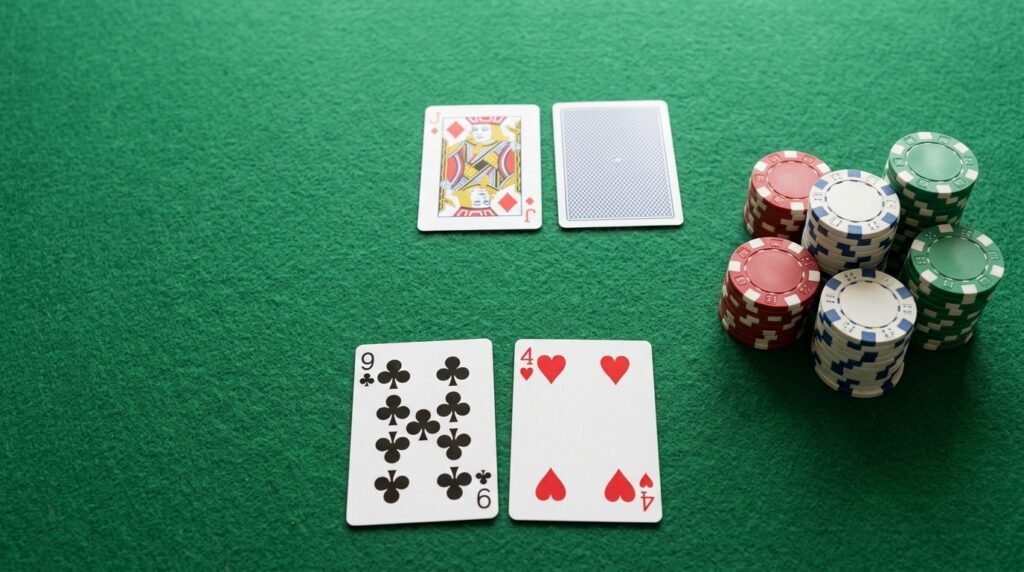
Blackjack follows a consistent structure regardless of where it’s played. Here’s how a single round unfolds:
- Placing bets — Each player places a wager before any cards are dealt.
- Initial deal — Every player receives two cards face-up; the dealer receives one face-up and one face-down card.
- Checking for blackjack — If a player’s first two cards total 21, that’s a natural blackjack, and it’s evaluated immediately.
- Player decisions — Each player chooses to hit (take another card), stand (keep their current total), double down, or split, depending on their hand.
- Dealer’s turn — Once all players finish, the dealer reveals their hidden card and plays according to fixed house rules.
- Comparing totals — Hands closest to 21 without exceeding it win; a tie is called a “push,” and no money changes hands.
- Settling the round — Winning hands are paid, losing hands are collected, and the next round begins.
Pro Tip: A natural blackjack (Ace + 10-value card on the first two cards) usually pays more than a standard win, since it’s the strongest possible hand in the game.
How the Game Mechanics Actually Work
Understanding the mechanics behind blackjack makes the rules click into place. Every card has a fixed point value: number cards count at face value, face cards count as 10, and the Ace flexibly counts as 1 or 11.
Your job as a player isn’t to hit exactly 21 — it’s to beat the dealer’s hand without going over 21 yourself, a situation called “busting.” This distinction matters because you’re not really playing against other players at the table; you’re playing against the dealer’s hand alone.
The dealer follows fixed rules with no personal choice involved. In most versions, the dealer must hit on 16 or lower and stand on 17 or higher. This structure is what makes blackjack feel more strategic than pure chance-based games — your decisions genuinely change the outcome, while the dealer’s moves stay predictable.
Common Beginner Mistakes to Avoid
New players tend to repeat the same handful of errors when they’re first learning what blackjack means in practice, not just in theory.
- Treating the Ace as always worth 11. This leads to unnecessary busts when a lower value would have kept the hand alive.
- Standing too early out of fear. Many beginners stop hitting well before their hand justifies it, missing safe opportunities to improve their total.
- Ignoring the dealer’s visible card. The dealer’s face-up card is a major clue for decision-making, and skipping this step leads to guesswork.
- Confusing “blackjack” with any 21. A three-card 21 is strong, but it isn’t the same as a natural blackjack and may pay differently.
- Splitting or doubling without understanding the math. These moves increase your wager, so using them without knowing when they help can backfire.
Blackjack Terminology Every Beginner Should Know
The language of blackjack can feel like a separate vocabulary at first. Here’s a breakdown of the terms you’ll hear most often:
- Hit — Requesting an additional card.
- Stand — Keeping your current hand and taking no more cards.
- Bust — Going over 21, which results in an automatic loss.
- Push — A tie between player and dealer; the bet is returned.
- Soft hand — A hand containing an Ace counted as 11 without busting.
- Hard hand — A hand with no Ace, or an Ace that must count as 1 to avoid busting.
- Double down — Doubling your original bet in exchange for exactly one more card.
- Split — Dividing two cards of equal value into two separate hands.
Knowing these terms isn’t just trivia — it directly affects how quickly you can follow along at a table or understand strategy charts.
Educational Strategy Tips for Understanding the Game Better
Strategy in blackjack isn’t about luck manipulation — it’s about pattern recognition and probability. Learning the basics helps you understand why certain decisions are mathematically sounder than others.
Start by learning how your hand total interacts with the dealer’s visible card. A dealer showing a low card (2 through 6) is statistically more likely to bust, which changes how aggressively you might want to hit or stand. A dealer showing a high card shifts the odds in the other direction.
Pro Tip: Basic strategy charts exist precisely because blackjack decisions follow predictable probability patterns — they’re a study tool, not a shortcut around understanding the game.
Soft hands (with a flexible Ace) give you more room to hit without fear of busting, since the Ace can drop from 11 to 1 if needed. Recognizing soft versus hard hands is one of the fastest ways to sharpen your decision-making as a beginner.
Myths vs. Facts About Blackjack
Misunderstandings about blackjack spread easily, especially among people who’ve only seen the game in movies.
Myth: Card counting is illegal. Fact: Counting cards isn’t illegal under any law — it’s simply a mental strategy tracking probability, though venues can ask a player to stop.
Myth: The dealer chooses when to hit or stand. Fact: Dealers follow fixed, predetermined rules with zero personal discretion.
Myth: A three-card 21 is the same as blackjack. Fact: Only a two-card Ace-plus-10 combination qualifies as a natural blackjack; a three-card 21 is a strong hand, but a separate category entirely.
Myth: Blackjack odds are the same everywhere. Fact: Rule variations (like how many decks are used) change the underlying odds significantly from one version to another.
Blackjack Hand Types Comparison Table
| Hand Type | Composition | Value | Notes |
|---|---|---|---|
| Natural Blackjack | Ace + 10-value card (first two cards) | 21 | Strongest possible hand |
| Soft Hand | Includes an Ace counted as 11 | Varies | Flexible, lower bust risk |
| Hard Hand | No Ace, or Ace must count as 1 | Varies | Less flexible, higher bust risk |
| Bust Hand | Any combination exceeding 21 | Over 21 | Automatic loss |
| Push Hand | Player and dealer totals match | Equal | Bet returned, no winner |
Conclusion
So, what does blackjack mean in cards? It’s both the name of the game and the term for the strongest hand in it — an Ace paired with a 10-value card for an unbeatable 21. Along the way, you’ve learned how the rules unfold step-by-step, which mechanics drive every decision, and the terminology that separates confident players from confused ones.
Understanding these fundamentals turns blackjack from an intimidating table game into a logical, rule-based system you can actually follow. Which part of the game surprised you most — the terminology, the mechanics, or the myths? If you’re ready to go deeper, a guide on basic strategy charts is a natural next read.
Once you see the pattern behind every hand, blackjack stops looking like chance and starts looking like a game of decisions.
FAQs
What does blackjack mean in cards exactly?
Blackjack refers to a two-card hand totaling 21, made up of an Ace and any 10-value card (10, Jack, Queen, or King). It’s considered the strongest hand in the game and usually beats any other 21 made with three or more cards. The term also names the overall card game where this hand is the ultimate goal.
Is an Ace and a King a blackjack?
Yes, an Ace paired with a King on the first two cards is a natural blackjack, since the King counts as a 10-value card. The same applies to an Ace with a Queen, Jack, or 10. Any of these combinations equal 21 and qualify as the top-tier hand.
What’s the difference between blackjack and 21? “
21″ often refers to the general target number players aim for, while “blackjack” specifically means a two-card hand hitting that number using an Ace and a 10-value card. A three-card hand totaling 21 hits the same number but isn’t technically a blackjack. The distinction matters because payouts can differ between the two.
How many decks are used in blackjack?
Blackjack can be played with anywhere from one to eight decks, depending on the version. Common setups include:
- Single-deck games, which tend to favor sharper probability tracking.
- Multi-deck games (4-8 decks), which are more common in larger table settings.
- Double-deck games, a middle-ground format some tables use. The deck count affects overall odds and strategy decisions.
Can the dealer get a blackjack too?
Yes, the dealer can be dealt a natural blackjack just like any player, using the same Ace-plus-10-value combination. If both the dealer and a player have blackjack, the round is usually a push, meaning the bet is returned. If only the dealer has it, all remaining player hands typically lose.
Why is it called blackjack instead of 21?
The name is believed to trace back to early bonus payouts that rewarded a specific combination including the Ace of Spades and a black Jack (Jack of Clubs or Spades). Even though that bonus rule faded over time, the name stuck and became permanently attached to the game. “21” remains a common nickname referencing the target number itself.