Bluffing means betting or raising with a weak hand to convince opponents you have a strong one. Beginners struggle because they bluff too often, ignore board texture, and forget that timing matters more than confidence. Understanding hand ranges and table position fixes most of these early mistakes.
Most new players think bluffing is about acting tough. It isn’t. Poker bluffing tips for beginners almost always start with the same idea: a bluff only works when your story makes sense to the person across the table. Bet the wrong way at the wrong moment, and even a perfect poker face won’t save you.
This guide walks through what bluffing actually is, why so many beginners get it wrong, the mechanics behind a believable bluff, and the terminology you’ll need to follow any strategy conversation without feeling lost. By the end, you’ll understand the difference between a calculated bluff and a desperate one — and why that distinction matters more than any single hand.
What Is Bluffing and Why Beginners Struggle With It
Bluffing is a bet or raise made without the strongest hand, designed to make opponents fold hands that would otherwise beat you. It’s not lying with your face — it’s lying with your bet sizing, your timing, and the story your actions tell across a hand.
Beginners struggle with this concept for a few consistent reasons:
- They treat bluffing as a personality trait (“I’m good at faking it”) instead of a math-based decision.
- They bluff into players who are unlikely to fold, wasting chips against a hand that’s already committed.
- They ignore the board — the shared cards on the table — and bet in ways that don’t match a believable hand.
- They can’t read betting patterns yet, so they can’t predict how opponents will react.
The core issue is that new players focus on themselves during a bluff, when the entire play depends on the other person’s perspective. A bluff isn’t about what cards you’re holding. It’s about what your opponent believes you’re holding.
Rules Explained Step-by-Step
Before attempting any bluff, it helps to understand the basic sequence of a poker betting round. Here’s how it typically unfolds:
- Cards are dealt — each player receives their starting hand (two cards in Texas Hold’em).
- A betting round begins, moving clockwise from the player after the dealer.
- Each player chooses to check, bet, call, raise, or fold based on their hand and the action before them.
- Community cards are revealed in stages (the flop, turn, and river), with a betting round after each.
- A final showdown occurs if two or more players remain, comparing hands to determine the winner.
- A bluff can be attempted at any betting round, but its credibility depends on matching your bet to a hand that would logically be betting at that point.
Understanding this structure matters because a bluff placed at the wrong stage — say, a huge raise on a betting round where a cautious hand wouldn’t logically raise — breaks the illusion instantly.
How Bluffing Actually Works
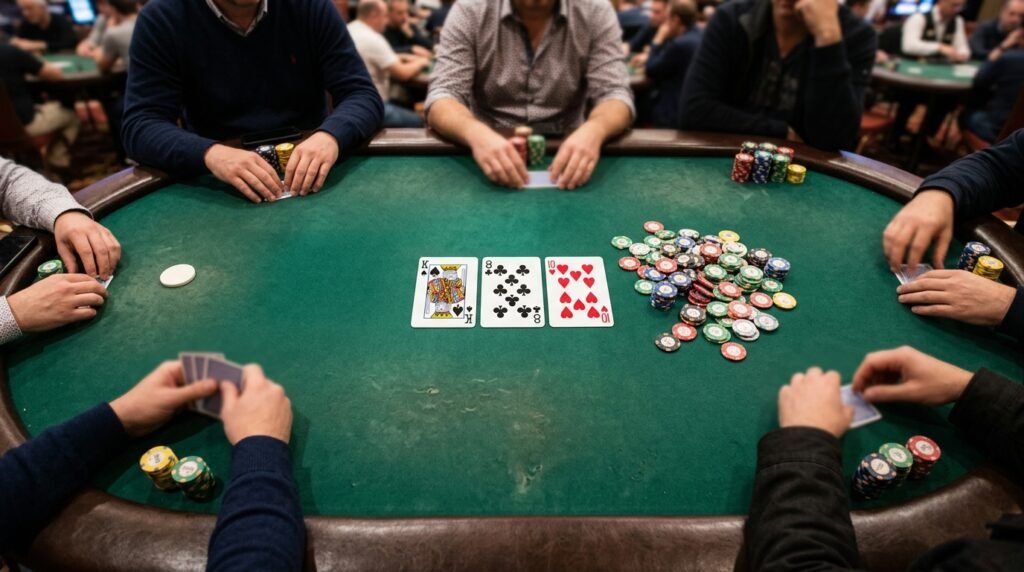
Bluffing works because poker is a game of incomplete information. No one at the table can see your cards, so every decision they make is based on inference — reading your bets, your timing, and the story those actions tell.
A believable bluff usually depends on three mechanics working together:
Board texture — cards that could plausibly form a strong hand (like three cards of the same suit) make bluffs more believable, because opponents can imagine you holding that hand.
Bet sizing consistency — if your bets look the same whether you’re strong or weak, opponents can’t use bet size to read you, which strengthens every bluff you attempt.
Position — acting after your opponents gives you more information about their hand strength before you decide whether a bluff is worth attempting.
Pro Tip: A bluff is far more convincing when the board changes in a way that could have improved your hand. Betting big on a card that doesn’t logically help anyone rarely fools an attentive opponent.
Common Beginner Mistakes to Avoid
New players tend to repeat the same handful of errors when they start experimenting with bluffs:
- Bluffing too frequently, which makes patterns easy to spot over time.
- Bluffing against multiple opponents at once, since the odds that at least one of them calls increase sharply.
- Ignoring stack sizes, and attempting a bluff against a player who’s already committed too many chips to fold.
- Using inconsistent bet sizing, which experienced players notice almost immediately.
- Bluffing purely out of frustration after losing a previous hand, rather than as a planned decision.
Pro Tip: If you notice yourself bluffing because you’re annoyed, not because the situation calls for it, that’s usually a sign to slow down and reassess the hand.
Terms and Terminology Explained
Poker conversations move fast, and a few terms come up constantly around bluffing:
- Tell — an unconscious behavior or pattern that reveals information about a player’s hand.
- Semi-bluff — betting with a hand that isn’t strong yet but has potential to improve, combining bluff and value in one move.
- Fold equity — the added value a bet gains from the chance an opponent folds, separate from the strength of your actual hand.
- Range — the full set of hands a player could realistically hold in a given situation, based on their actions.
- Continuation bet — a follow-up bet made by the player who was aggressive on the previous betting round, often used to represent continued strength.
Understanding these terms helps beginners follow strategy discussions without constantly stopping to look things up mid-hand.
Strategy Tips for Better Understanding
Improving your grasp of bluffing isn’t about memorizing tricks — it’s about recognizing patterns and thinking in terms of ranges rather than single hands.
A few habits that help beginners think more clearly about bluffing:
- Ask what story your bet tells, not just what cards you’re holding.
- Pay attention to how often opponents fold to aggression, since some players simply won’t fold regardless of the bet.
- Consider the number of players still in the hand — bluffs generally make more sense against fewer opponents.
- Review hands afterward and ask whether the bluff made logical sense given the board and betting history.
Pro Tip: Semi-bluffing — betting with a hand that could still improve — is often a safer way for beginners to practice bluffing concepts, since there’s a backup plan if the bluff doesn’t work.
Myths vs Facts
Myth: Bluffing is mostly about confidence and a good poker face.
Fact: Bluffing is primarily a mathematical and situational decision; physical composure matters far less than bet sizing, timing, and board texture.
Myth: Good players bluff constantly.
Fact: Skilled players bluff selectively, often less than beginners assume, because predictable bluffing is easy to exploit.
Myth: A bluff either works completely or fails completely.
Fact: Even a “failed” bluff can add long-term value by making future value bets harder for opponents to read.
Myth: Bluffing more against beginners is a safe strategy.
Fact: Inexperienced players often call more often, regardless of logic, which can make bluffs less effective against them.
Comparison: Types of Bluffs Beginners Should Know
| Bluff Type | When It’s Used | Risk Level | Beginner-Friendly? |
|---|---|---|---|
| Pure Bluff | Weak hand with little improvement potential | High | Not recommended early on |
| Semi-Bluff | Hand with drawing potential (e.g., a flush draw) | Medium | Yes |
| Continuation Bet | Following up aggression from a prior round | Medium | Yes, with practice |
| Squeeze Bluff | Raising after multiple players have called | High | Not recommended early on |
Bringing It All Together
Bluffing isn’t a shortcut to winning — it’s a tool that depends on reading situations correctly. The board, your position, your opponents’ tendencies, and your own betting consistency all shape whether a bluff has a real chance of working.
To recap the three ideas that matter most:
- A bluff only works if it tells a believable story, based on the board and betting history.
- Beginners bluff too often and too predictably, which makes them easy to read over time.
- Semi-bluffing offers a safer way to practice the concept, since it leaves room for the hand to improve naturally.
So the next time you’re tempted to push chips forward on a weak hand, ask yourself: does this bet actually make sense to the person watching it? If you can answer that honestly, you’re already ahead of most beginners. Curious how position affects these decisions? That’s worth exploring next.
FAQs
What is bluffing in poker for beginners?
Bluffing is betting or raising without the strongest hand in order to convince opponents to fold a better one. For beginners, the key is understanding that a bluff depends on context — the board, your position, and betting history — rather than simply acting confident. It’s a calculated move, not a personality trait.
How often should a beginner bluff in poker?
There’s no fixed number, but beginners generally bluff too often. A more useful approach is to bluff selectively: 1) when the board favors a strong hand, 2) against fewer opponents, and 3) when your prior betting has been consistent. Quality matters more than frequency.
What is a semi-bluff in poker?
A semi-bluff is a bet made with a hand that isn’t strong yet but has the potential to improve, such as a flush or straight draw. It combines two winning paths: opponents might fold immediately, or your hand might improve if they call. This makes it a common recommendation among poker bluffing tips for beginners.
How do you know if someone is bluffing in poker?
There’s no single reliable “tell,” but inconsistent bet sizing, unusual timing, and bets that don’t match the board texture are common indicators. Experienced players focus more on betting patterns over multiple hands than on physical behavior, since patterns are far more reliable than assumptions about body language.
Why do poker bluffing tips for beginners emphasize position?
Position determines how much information you have before acting. Players in later position see how others react first, making it easier to judge whether a bluff is likely to succeed. Beginners who bluff from early position often lack the information needed to judge opponents’ likely hands.
Is bluffing necessary to win at poker?
No — many strong players win primarily through solid value betting and hand selection, using bluffs only occasionally. Bluffing is one tool among several, and beginners often overestimate how central it is compared to fundamentals like position, hand ranges, and disciplined folding.